Can Raccoons Be Pets? Laws, Care, Risks, and Welfare
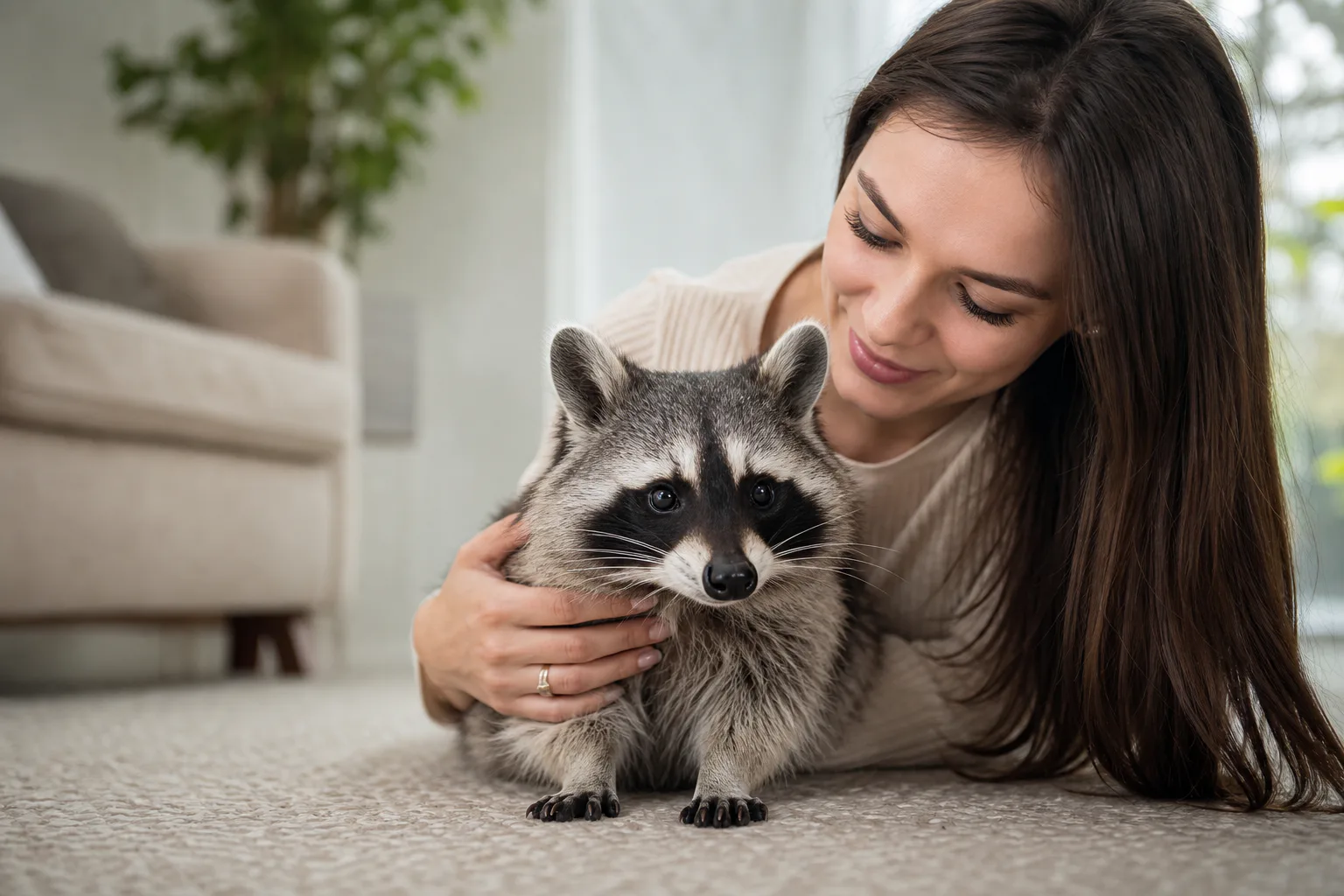
Short answer: A pet raccoon can be intelligent, curious, playful, and affectionate, but a raccoon is a wild animal, not domesticated like a cat or dog. Ownership is illegal or heavily restricted in many places, and even a hand-raised raccoon can develop an unpredictable temperament, destructive habits, and aggressive behavior as it approaches sexual maturity.
This guide explains the legal, behavioral, health, housing, dietary, veterinary, and welfare issues involved. It also explains why caring for an orphaned raccoon through licensed wildlife rehabilitation is different from keeping one permanently as a companion.
The short answer
Raccoons may bond with people, especially during their first months of life. A raccoon kit can be affectionate and playful, but early attachment does not make the animal domesticated or guarantee safe adult behavior.
Raccoons remain nocturnal, omnivorous wild animals with strong instincts to climb, forage, investigate, bite, scratch, escape, and defend themselves. Adult raccoons can show aggressive behavior as young as six months old when they have not been domesticated, and no amount of affection removes the risks associated with keeping a wild animal in a home.
- Legal status: State regulations and local rules may prohibit ownership, require permits, or allow only legally bred animals.
- Safety: Raccoons can cause biting and scratching injuries and carry zoonotic diseases.
- Practical demands: They need secure, enriched housing, specialized veterinary treatment, and constant supervision.
- Long-term welfare: A captive raccoon can live for 16 years or more, creating a commitment that extends far beyond the appealing kit stage.
Are raccoons legal to own?
Raccoon ownership depends on the animal’s origin, your state, your county or city, and the required permits. One U.S. ranking counted ownership as legal in 13 states, while other summaries describe fewer than 20 states as allowing it under some conditions. Those figures are not a substitute for checking current law.
Before acquiring any raccoon, contact your state wildlife agency, local animal control office, and health department. Ask specifically about possession, transport, enclosure standards, veterinary care, sale, breeding, and what happens after a bite or escape.
- A wild-caught raccoon may be prohibited even where a legally bred animal is allowed.
- A permit may not make ownership legal inside a particular city or county.
- Some jurisdictions restrict ownership to a licensed breeder, exhibitor, or wildlife rehabilitator.
- Rules can change, so written confirmation from the relevant authority is safer than relying on an online advertisement or social-media post.
Searches such as “pet raccoon NJ,” “pet raccoon NC,” or “pet raccoon legal states” cannot answer the question for an individual household. Regulations differ within states, and possession that appears legal may still be impractical because no local veterinarian, boarding service, or emergency facility will accept the animal.
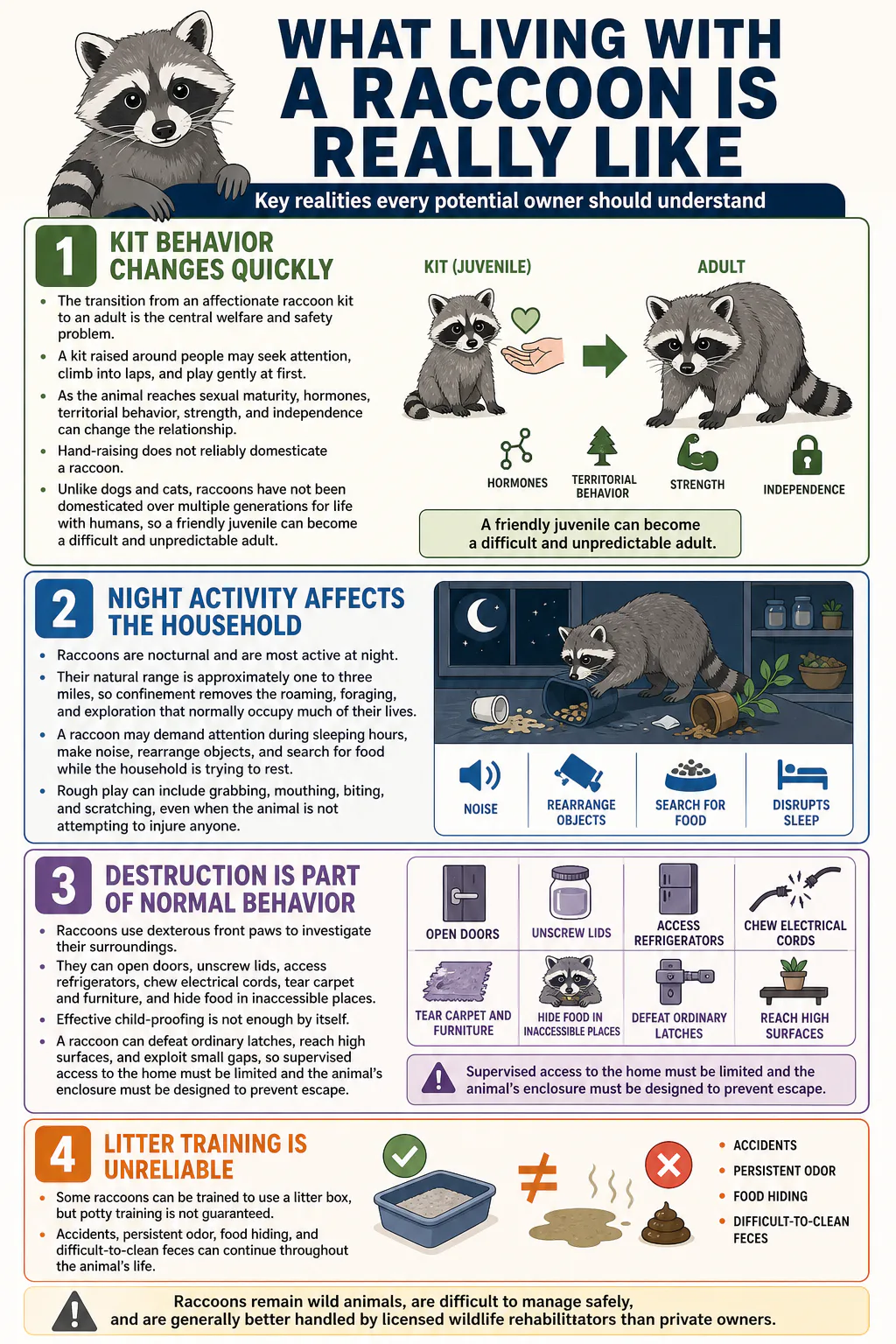
What living with a raccoon is really like
Kit behavior changes quickly
The transition from an affectionate raccoon kit to an adult is the central welfare and safety problem. A kit raised around people may seek attention, climb into laps, and play gently at first. As the animal reaches sexual maturity, hormones, territorial behavior, strength, and independence can change the relationship.
Hand-raising does not reliably domesticate a raccoon. Unlike dogs and cats, raccoons have not been domesticated over multiple generations for life with humans, so a friendly juvenile can become a difficult and unpredictable adult.
Night activity affects the household
Raccoons are nocturnal and are most active at night. Their natural range is approximately one to three miles, so confinement removes the roaming, foraging, and exploration that normally occupy much of their lives.
A raccoon may demand attention during sleeping hours, make noise, rearrange objects, and search for food while the household is trying to rest. Rough play can include grabbing, mouthing, biting, and scratching, even when the animal is not attempting to injure anyone.
Destruction is part of normal behavior
Raccoons use dexterous front paws to investigate their surroundings. They can open doors, unscrew lids, access refrigerators, chew electrical cords, tear carpet and furniture, and hide food in inaccessible places.
Effective child-proofing is not enough by itself. A raccoon can defeat ordinary latches, reach high surfaces, and exploit small gaps, so supervised access to the home must be limited and the animal’s enclosure must be designed to prevent escape.
Litter training is unreliable
Some raccoons can be trained to use a litter box, but potty training is not guaranteed. Accidents, persistent odor, food hiding, and difficult-to-clean feces can continue throughout the animal’s life.
Health risks
Raccoons can carry several zoonotic infections, meaning diseases that can pass from animals to people. The risks affect owners, children, visitors, other pets, veterinary staff, and anyone cleaning the enclosure.
- Rabies: Raccoons are an important rabies reservoir in the United States, and there is no approved rabies vaccine for raccoons. A bite or scratch requires prompt medical and public-health assessment.
- Raccoon roundworm: Droppings can contain eggs of Baylisascaris procyonis. Contaminated material can become airborne, creating a serious exposure risk during cleaning.
- Other infections: Raccoons can carry leptospirosis, giardiasis, salmonella, and canine distemper.
- Parasites: Fleas and ticks can spread to people and other animals in the household.
A bite or scratch creates a serious public-health problem even if the raccoon appears healthy. Authorities may require the animal to be euthanized and submitted for rabies testing, including examination of the brain, because routine observation cannot resolve every exposure.
Anyone bitten or scratched should wash the wound immediately and seek urgent medical advice. Report the incident to animal control or the health department, and do not attempt to hide, move, release, or dispose of the animal.
Housing and escape prevention
A large dog crate is suitable only for short periods. A captive raccoon needs substantial space to roam, climb, manipulate objects, rest, forage, and explore without constant exposure to household hazards.
Minimum housing priorities
- A spacious, escape-proof enclosure with a secure roof
- Strong doors and latches that the raccoon cannot manipulate
- Climbing structures, platforms, hiding areas, and durable toys
- Safe materials that tolerate chewing, digging, water, and repeated cleaning
- Protection from heat, cold, predators, and contact with wild animals
- Daily enrichment that encourages safe foraging and problem-solving
- Separate areas for food, rest, elimination, and water
Indoor access requires extensive child-proofing and electrical-cord protection. Even then, the raccoon should not roam unsupervised around kitchens, bedrooms, garages, stairs, or rooms containing fragile furniture and household chemicals.
Routine pet supplies are not a substitute for species-appropriate housing. A secure enclosure, enrichment equipment, cleaning tools, and replacement materials must be selected for a strong, climbing, escape-prone wild animal.
What do pet raccoons eat?
Raccoons are omnivorous and naturally eat fruits, nuts, corn, fish, frogs, insects, bird eggs, rodents, poultry, and carrion. A captive diet must provide variety without allowing the high-calorie foods that can cause obesity.
- A high-quality commercial raccoon or omnivore diet
- Fresh fruits and vegetables in controlled portions
- Cooked lean protein
- Appropriate nuts and seeds
- Fiber and vitamins or minerals when recommended by a veterinarian
- Constant access to clean water
Raccoons often dip food in water before eating, so a shallow water dish should be stable, washable, and refreshed frequently. Diets based mainly on treats, fatty leftovers, or unrestricted commercial food can lead to nutritional problems and excess weight.
Some caretakers use dog food as one component of a broader diet, but it should not replace professional nutritional guidance for a raccoon. An exotic-pet veterinarian can adjust portions and ingredients for age, body condition, health, and activity.
Veterinary care and commitment
Locate an exotic-pet veterinarian before bringing a raccoon home. Not every clinic treats raccoons, and emergency care, anesthesia, diagnostic testing, parasite control, dental treatment, and other veterinary treatment can require a specialist.
Routine care also involves difficult planning. Pet-sitting is limited because many sitters, boarding facilities, and landlords will not accept a raccoon, and a caretaker must understand enclosure security, cleaning, feeding, and bite prevention.
The financial commitment includes the enclosure, repairs, enrichment, specialized food, sanitation, veterinary treatment, emergency transport, and legal permits where required. Dog-focused insurance should not be assumed to cover an exotic animal; confirm coverage terms directly with the insurer before relying on a policy.
A captive raccoon can live for 16 years or more, creating a long-term responsibility involving housing, travel, employment, family changes, and emergency planning.
Pet ownership versus wildlife rehabilitation
| Permanent pet ownership | Wildlife rehabilitation |
|---|---|
| Attempts to keep the raccoon as a companion | Provides temporary care with the goal of release |
| Encourages human attachment and household dependence | Uses controlled contact to reduce imprinting |
| Requires lifelong housing and private veterinary planning | Operates under permits, veterinary protocols, and release standards |
| Cannot safely solve a difficult adult behavior by releasing the animal | Prepares a healthy animal for release into an appropriate protected release area |
Wildlife rehabilitation is a professional process, not a casual form of pet adoption. A wildlife rehabilitator evaluates orphaned kits, provides species-appropriate care, limits human contact, teaches natural behaviors, and determines whether the animal is ready for release.
Healthy orphaned raccoon kits may be released at around 12 weeks, and a healthy 10-week-old kit may sometimes be ready. The timing depends on development, health, feeding ability, weather, habitat, and the rules governing the release site.
Do not take a healthy wild raccoon from outdoors to raise as a pet. If you find an orphaned raccoon, keep people and pets away, avoid unnecessary handling, and contact a licensed wildlife rehabilitator or animal control office for instructions.
A captive raccoon that has become difficult to manage should not be released into the wild. It may lack survival skills, starve, spread disease, or damage property, and an unsuitable release can also harm established wildlife populations.
Frequently asked questions
Are raccoons good pets?
No. Raccoons can be intelligent, playful, and affectionate, but their adult behavior, health risks, legal restrictions, nocturnal schedule, and destructive instincts make them unsuitable for most households.
Can you own a raccoon as a pet?
In some jurisdictions, possession is allowed under specific conditions. Check current state regulations and local rules with wildlife authorities before considering a legally bred animal.
Are raccoons legal pets in the UK?
Private ownership of raccoons in the UK is prohibited or tightly restricted under invasive-species rules. Confirm the current requirements with the relevant UK authority rather than relying on a seller’s claim.
Which states allow raccoons as pets?
There is no single nationwide list that resolves every case because state, county, and city rules differ. Ownership may be allowed only under specific conditions, such as a permit or lawful captive origin, and local authorities determine how those rules apply to a household.
Can I buy a pet raccoon for sale?
Do not purchase a raccoon from an unverified seller or take one from the wild. Where possession is legal, confirm the seller’s licensing, the animal’s lawful origin, health records, and the permits required in your location.
Can I adopt a pet raccoon?
Wildlife rehabilitators do not treat healthy orphaned kits as ordinary adoptable pets. Their goal is rehabilitation and release, while permanently non-releasable animals require placement approved by the appropriate authorities.
How much does a pet raccoon cost?
The purchase price is only one part of the decision and varies by location and legal status. Enclosure construction, repairs, food, sanitation, permits, specialist veterinary care, and emergency treatment can create a substantial long-term expense.
How long does a pet raccoon live?
A captive raccoon can live for 16 years or more, with some accounts reporting up to 20 years. Plan for a long-term commitment rather than a short experience with a raccoon kit.
What should I do if I find a raccoon?
Keep children and pets away and do not handle the animal unless a professional directs you to do so. Contact a licensed wildlife rehabilitator, animal control office, or local wildlife authority, especially if the raccoon is injured, unusually aggressive, or appears to be an orphaned kit.
Final verdict
A pet raccoon is rarely a responsible choice for a private home. The animal remains wild and not domesticated, ownership may be unlawful, disease exposure can be severe, and adult behavior can make safe lifelong care difficult.
If you want a companion animal, choose a domesticated species suited to household life, such as a cat. If you want to help raccoons, support wildlife rehabilitation or contact a licensed rehabilitator when you find an orphaned or injured animal.
Historical examples, including raccoons kept during Calvin Coolidge’s presidency and animals known as Tiki and Buddy, do not change the welfare realities. Admiring raccoons is compatible with protecting them, and for most people the safest choice is to observe them responsibly in the wild rather than keep one as a pet.