Cat Age Calculator: Human Age Chart, Formula and Life Stages

A cat’s first two years bring far more change than the familiar “one cat year equals seven human years” rule suggests. A Cat Age Calculator uses a more realistic conversion: the first cat year equals about 15 human years, the second brings the total to 24, and every year after that adds approximately four human years.
Use the chart and formula below to estimate your cat’s human-age equivalent, understand its life stage, and interpret what the number means for everyday care.
How cat age conversion works
Cats mature quickly during their first two years. A one-year-old cat is not equivalent to a seven-year-old child; it has generally reached a level of physical and social maturity closer to a 15-year-old human.
- Cat year one: approximately 15 human years
- Cat year two: approximately 24 human years total
- Each year after age two: add approximately four human years
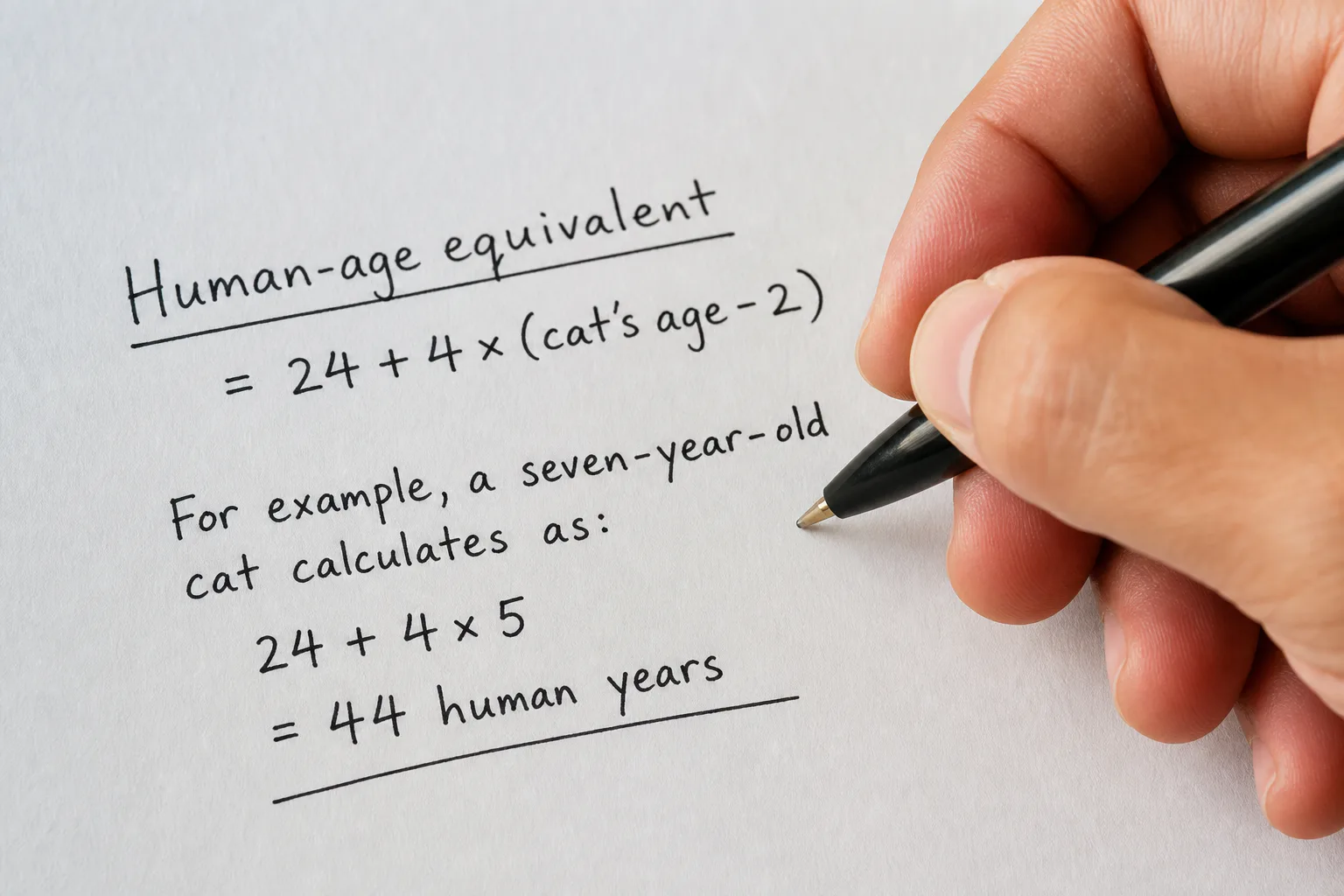
For cats older than two, the calculation is:
Human-age equivalent = 24 + 4 × (cat’s age − 2)
For example, a seven-year-old cat calculates as 24 + 4 × 5, or approximately 44 human years.
Cat age chart
| Cat age | Approximate human equivalent | Common life stage |
|---|---|---|
| 1 month | Early kitten development | Kitten |
| 6 months | Early adolescence | Kitten |
| 1 year | 15 years | Young adult |
| 2 years | 24 years | Young adult |
| 3 years | 28 years | Young adult |
| 5 years | 36 years | Adult |
| 7 years | 44 years | Mature adult |
| 10 years | 56 years | Mature or senior |
| 12 years | 64 years | Senior |
| 14 years | 72 years | Senior |
| 15 years | 76 years | Older senior |
| 20 years | 96 years | Very old |
The chart provides an estimate rather than a medical measurement. Breed, genetics, previous illness, body condition, dental health, and access to veterinary care all affect how an individual cat ages.
Examples from the calculator
How old is seven in cat years?
A seven-year-old cat is approximately 44 human years old. This is generally a mature adult, so preventive examinations, dental care, weight monitoring, and changes in behavior deserve consistent attention.
How old is twelve in cat years?
A 12-year-old cat is approximately 64 human years old. Twelve is commonly considered a senior age, although many cats remain active and comfortable well beyond this point.
Is fourteen very old for a cat?
Fourteen corresponds to approximately 72 human years. It is an advanced age, but it does not automatically mean that a cat is frail or seriously ill. A healthy 14-year-old cat can still have good quality of life with appropriate monitoring and treatment.
How old is a 20-year-old cat?
Using the standard conversion, a 20-year-old cat is approximately 96 human years old. Reaching 20 is uncommon enough to represent exceptional longevity, and age-related changes should be assessed rather than assumed to be normal.

Using months and weeks
A kitten’s age is often recorded in months because development changes rapidly during the first year. A Cat Age Calculator that accepts months can provide a more useful estimate than simply rounding a young kitten down to zero or up to one year.
Weeks are especially useful for very young kittens, including those being fostered or prepared for adoption. At this stage, age estimates are best combined with physical signs such as eye development, teeth, coordination, weight, and behavior.
There is no single universally exact human-age value for every kitten month or week. The standard conversion is most consistent from the first birthday onward, while early-life estimates should be treated as developmental approximations.
Life stages by age
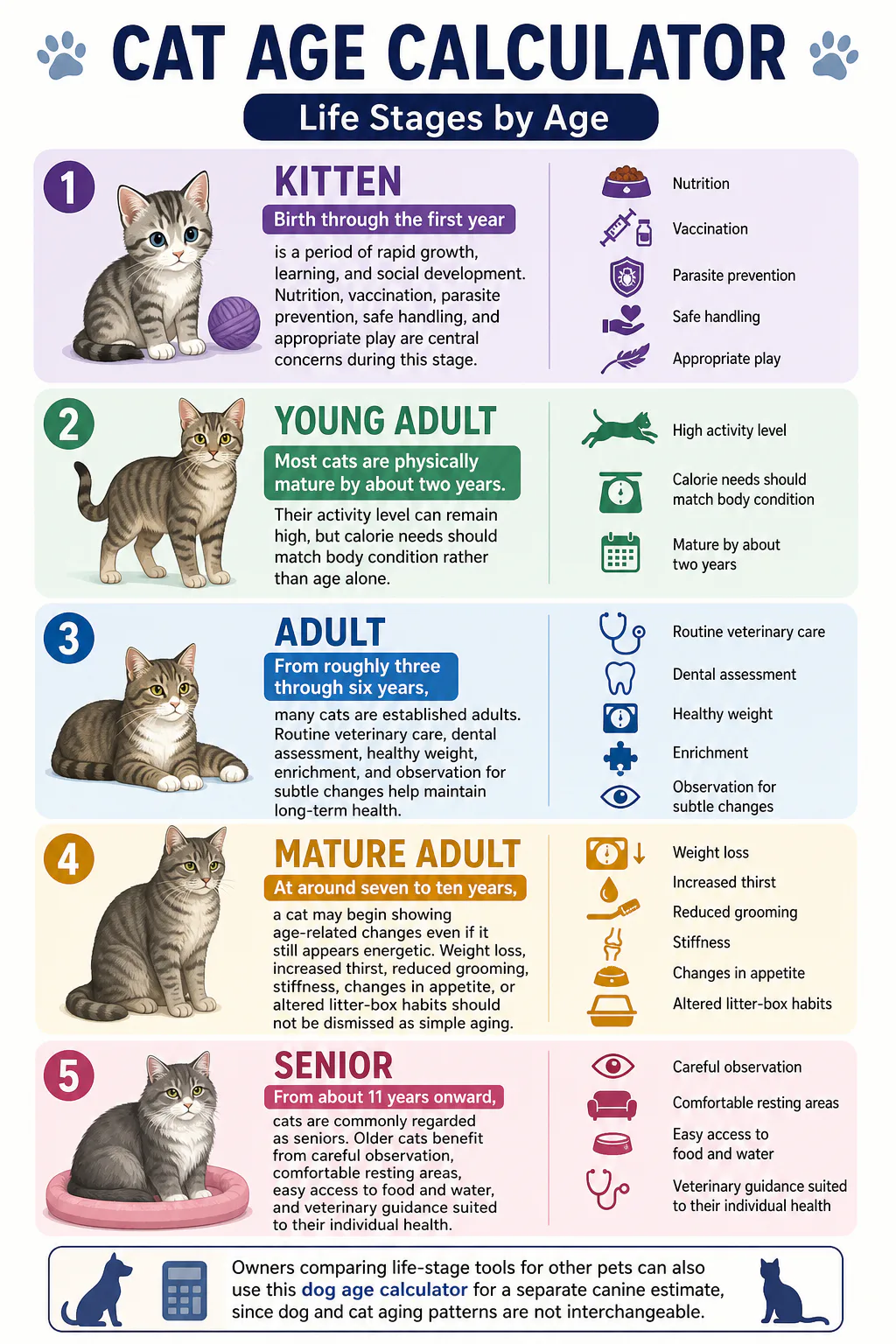
Kitten
Birth through the first year is a period of rapid growth, learning, and social development. Nutrition, vaccination, parasite prevention, safe handling, and appropriate play are central concerns during this stage.
Young adult
Most cats are physically mature by about two years. Their activity level can remain high, but calorie needs should match body condition rather than age alone.
Adult
From roughly three through six years, many cats are established adults. Routine veterinary care, dental assessment, healthy weight, enrichment, and observation for subtle changes help maintain long-term health.

Mature adult
At around seven to ten years, a cat may begin showing age-related changes even if it still appears energetic. Weight loss, increased thirst, reduced grooming, stiffness, changes in appetite, or altered litter-box habits should not be dismissed as simple aging.
Senior
From about 11 years onward, cats are commonly regarded as seniors. Older cats benefit from careful observation, comfortable resting areas, easy access to food and water, and veterinary guidance suited to their individual health.
Owners comparing life-stage tools for other pets can also use this dog age calculator for a separate canine estimate, since dog and cat aging patterns are not interchangeable.
How to estimate an unknown age
Adopted cats often arrive without a confirmed birth date. A veterinarian can estimate age by examining physical development and health indicators, although an exact age may not be possible, especially for mature or senior cats.
- Teeth: kittens’ teeth and dental wear provide useful clues.
- Eyes: lens clarity and other eye changes can help distinguish younger from older cats.
- Coat and skin: texture, grooming condition, and gray hairs may add context.
- Muscle and body condition: reduced muscle or stiffness can indicate later life, but illness can cause similar signs at any age.
- Behavior: activity, confidence, and sleep patterns offer supporting clues rather than a precise date.
These signs should be considered together. Dental disease, poor nutrition, chronic illness, or previous living conditions can make a cat look older or younger than it is.
What the number cannot tell you
A human-age equivalent helps explain maturity, but it cannot diagnose a condition or predict an individual cat’s lifespan. Two cats of the same chronological age can have different mobility, dental health, body condition, and medical needs.
Use age conversion as a guide for questions to discuss with a veterinarian. A sudden change in appetite, thirst, weight, breathing, movement, grooming, or litter-box use deserves attention at any age.
Frequently asked questions
Is the seven-year rule accurate?
No. The seven-year rule is a simple shortcut that does not reflect cats’ rapid development during their first two years. The 15-24-4 method gives a more useful general estimate.

Does indoor living change the calculation?
No. A cat’s chronological age is converted using the same general formula. Indoor living can affect health risks and longevity, but it does not change the mathematical age estimate.
Can a calculator determine an exact age?
No. It can convert a known or estimated chronological age into an approximate human equivalent. For a cat with an unknown birth date, a veterinary examination provides a more informed age estimate.
Should senior cats receive different care?
Senior cats should have their health monitored closely, but care should be individualized. Diet, exercise, dental treatment, medication, and examination frequency depend on the cat’s condition rather than the calculator result alone.
Final guidance
For a quick estimate, remember three figures: one cat year equals about 15 human years, two cat years equal about 24, and each later year adds about four. Enter the most accurate age available, use the result to place your cat in context, and treat changes in health or behavior as reasons for veterinary advice rather than as inevitable signs of aging.