Dog Age Calculator: Human-Age Estimates by Size and Life Stage

Dog Age Calculator results are estimates, not exact biological conversions. A two-year-old dog is generally comparable to a 24-year-old human, but breed, adult size, health, and life stage affect the result. Use a calculator as a practical guide for understanding your dog’s development and care needs, not as a medical measurement.
How Dog Age Conversion Works
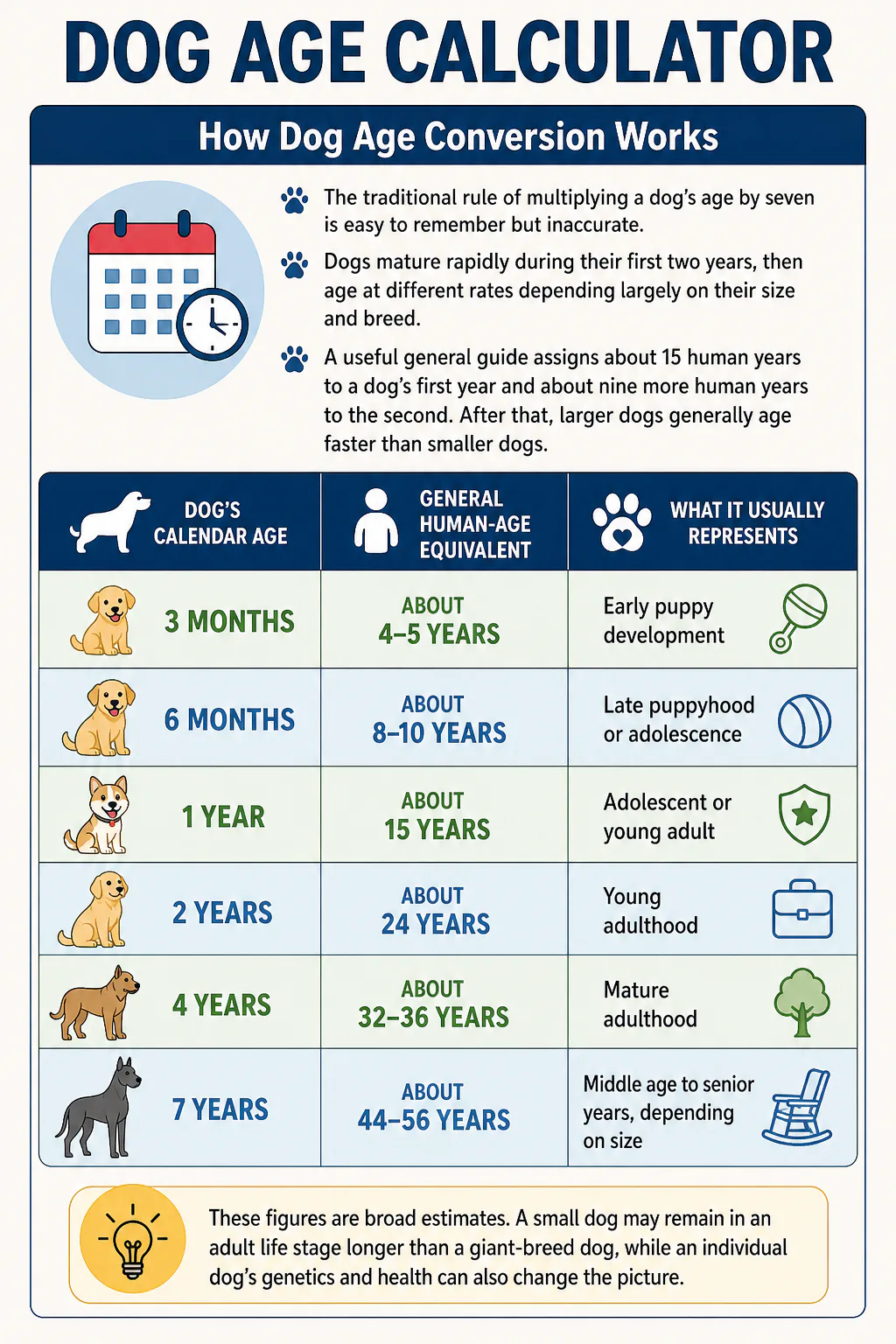
The traditional rule of multiplying a dog’s age by seven is easy to remember but inaccurate. Dogs mature rapidly during their first two years, then age at different rates depending largely on their size and breed.
A useful general guide assigns about 15 human years to a dog’s first year and about nine more human years to the second. After that, larger dogs generally age faster than smaller dogs.
| Dog’s calendar age | General human-age equivalent | What it usually represents |
|---|---|---|
| 3 months | About 4–5 years | Early puppy development |
| 6 months | About 8–10 years | Late puppyhood or adolescence |
| 1 year | About 15 years | Adolescent or young adult |
| 2 years | About 24 years | Young adulthood |
| 4 years | About 32–36 years | Mature adulthood |
| 7 years | About 44–56 years | Middle age to senior years, depending on size |
These figures are broad estimates. A small dog may remain in an adult life stage longer than a giant-breed dog, while an individual dog’s genetics and health can also change the picture.

Using a Dog Age Calculator
A reliable calculator should begin with your dog’s actual age in years and months. It should also account for size or breed rather than applying one conversion rate to every dog.
- Enter your dog’s calendar age.
- Include months when your dog is younger than two years or close to a life-stage transition.
- Select the closest adult-size group if the calculator requests it.
- Read the human-age estimate together with the life-stage description.
- Use the result to discuss preventive care with your veterinarian.
For puppies, an age calculator in months or weeks is more useful than a whole-year conversion. Development changes quickly during the first year, so a three-month-old puppy and a nine-month-old puppy have very different physical, behavioral, and nutritional needs.
Why Size Changes the Result
Dogs do not age at one uniform rate. Small dogs often have longer lifespans and slower aging after maturity, while large and giant breeds frequently reach senior life stages earlier.
- Small dogs: often age more slowly after early adulthood.
- Medium dogs: generally fall near the middle of common conversion charts.
- Large dogs: often reach later life stages sooner.
- Giant breeds: can have a shorter adult lifespan and faster age-related changes.
Breed-specific calculators can provide a more tailored estimate, but they still cannot predict an individual dog’s lifespan or health. The estimate is most useful when combined with your dog’s examination history, weight, mobility, dental health, and behavior.
Common Dog Age Examples
How old is a two-year-old dog?
A two-year-old dog is approximately 24 human years old under a widely used general conversion. This estimate reflects the dog’s rapid development during its first two years and applies best as a broad life-stage comparison.

How old is seven years for a dog?
Seven calendar years can correspond to roughly 44 to 56 human years. A small dog may be closer to the lower end of that range, while a large or giant-breed dog may be closer to the higher end.
How old is a three-month-old puppy?
A three-month-old puppy is approximately equivalent to a four- or five-year-old child in broad developmental terms. This comparison does not mean the puppy has the reasoning, emotional development, or care needs of a human child of that age.
How old is four dog years?
A four-year-old dog is generally comparable to a human in their early to mid-30s. The estimate varies with size, so a small dog may receive a lower human-age equivalent than a large dog.
Calendar Age Versus Life Stage
Human-age estimates can make a dog’s age easier to understand, but life stage is often more useful for day-to-day decisions. Puppies need socialization, training, growth-appropriate nutrition, and carefully managed exercise. Adult dogs need routine preventive care and weight control, while senior dogs may benefit from more frequent health monitoring.
Watch for changes that matter more than the calculator’s number:
- Reduced stamina or difficulty climbing stairs
- Changes in appetite, thirst, weight, or sleep
- Stiffness, limping, or reluctance to play
- Hearing, vision, dental, or toileting changes
- New anxiety, confusion, irritability, or withdrawal
Sudden changes should be assessed by a veterinarian regardless of the dog’s calculated human age. A calculator cannot diagnose arthritis, cognitive decline, dental disease, or other medical conditions.

Limitations of Dog Years
There is no single conversion that accurately describes every dog. Age calculators simplify complex differences in breed, body size, genetics, environment, nutrition, and medical history.
Some scientific models use a nonlinear formula rather than the seven-year rule. One commonly discussed model estimates human age with a logarithmic calculation, expressed as human age = 16 × ln(dog age) + 31, but it is not a universal standard and is less practical for puppies or breed-specific comparisons.
For everyday use, a size-adjusted chart is easier to interpret. Treat the result as an approximate reference and use veterinary guidance for decisions about screening, medication, exercise, or diet.
Frequently Asked Questions
How do I calculate a dog’s age?
Start with the dog’s calendar age, then use a conversion that considers the dog’s size or breed. A general estimate is 15 human years for the first dog year, 24 human years by the second year, and progressively different rates after that based on adult size.
Is a dog age calculator the same as a human years to dog years calculator?
They describe opposite directions of the same comparison. A dog age calculator converts a dog’s calendar age into an estimated human-age equivalent, while a human-years-to-dog-years calculator estimates the dog’s calendar age or life stage represented by a human age.

Can I calculate puppy age in weeks?
Yes. For young puppies, enter the age in weeks or convert weeks into months before using a puppy age calculator. Week-by-week information is helpful for tracking growth and development, but it should not replace guidance from a veterinarian or responsible breeder.
Does the seven-year rule work?
No. The seven-year rule overlooks the rapid development of puppies and the different aging patterns of small, medium, large, and giant dogs. It can provide a rough comparison, but a size-adjusted calculator is more informative.
Making the Estimate Useful
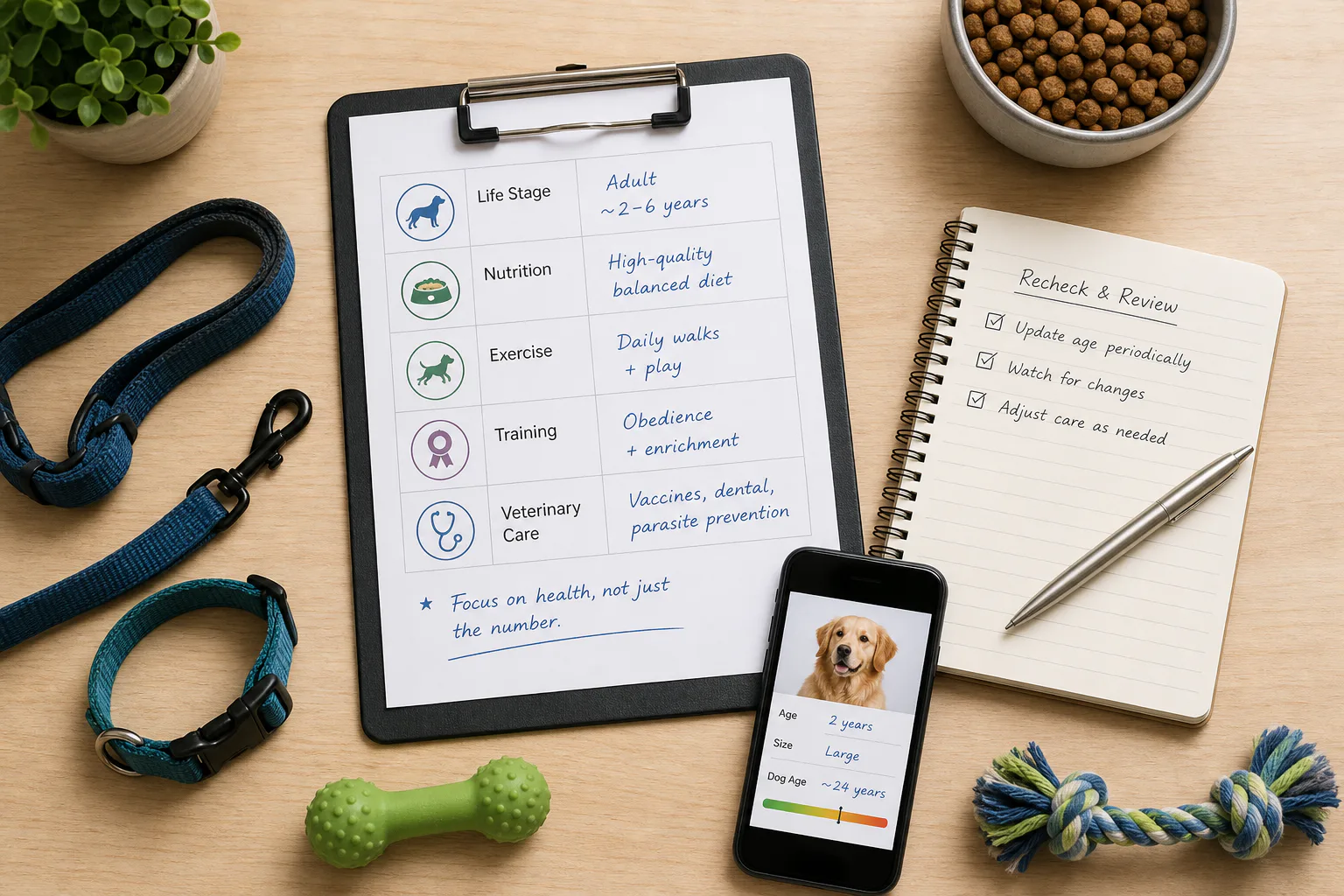
Enter your dog’s most accurate age, select the correct size group, and record the result alongside the dog’s current life stage. Recheck the estimate as your dog grows, but focus on health changes and preventive-care recommendations rather than the number alone.
The best use of a Dog Age Calculator is simple: use it to understand your companion’s stage of life, then tailor nutrition, exercise, training, and veterinary care to the individual dog.