Mini Goldendoodle Overview: Size, Temperament & Care
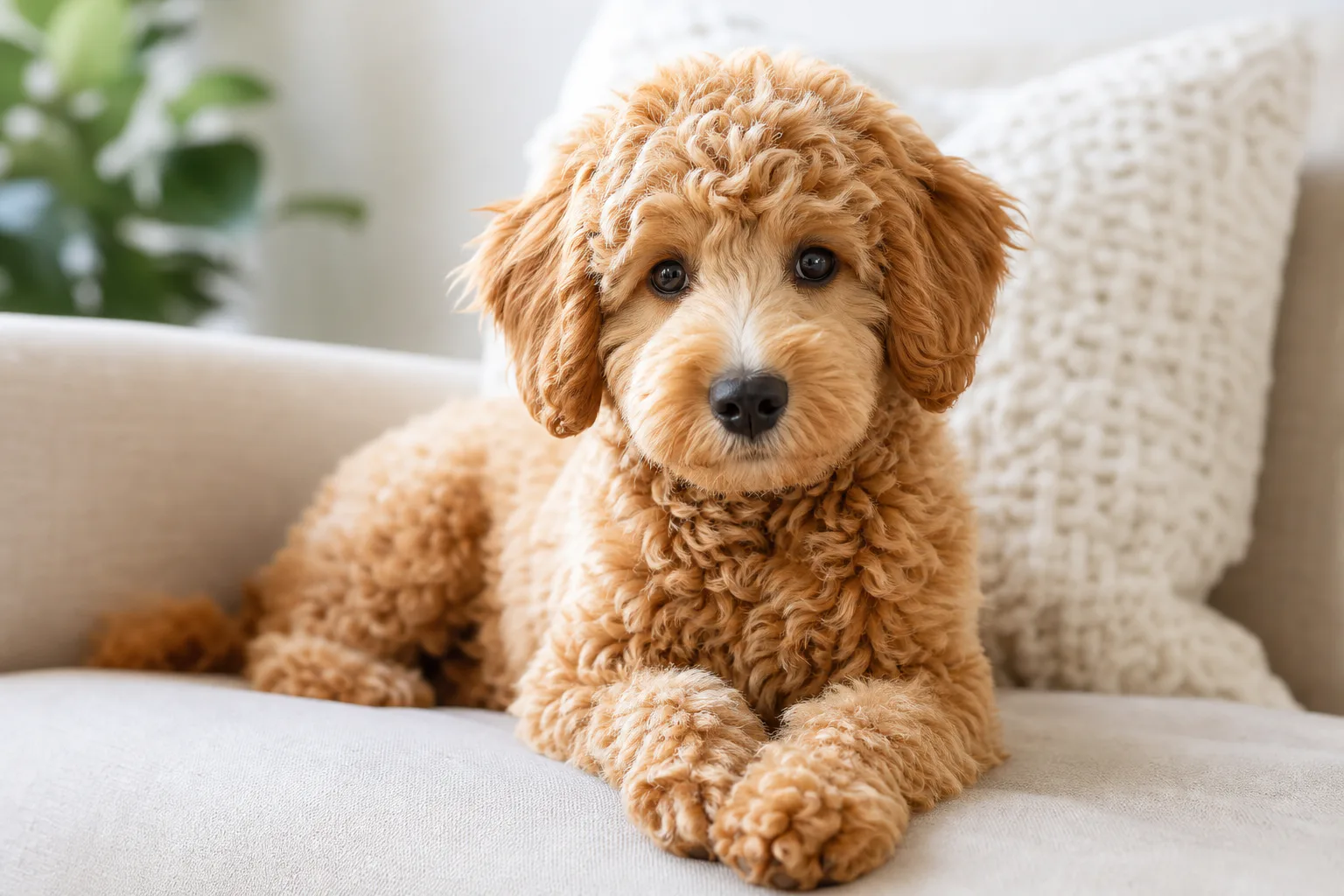
A Mini Goldendoodle is a cross between a Golden Retriever and a Miniature Poodle, bred to combine a companionable temperament with a smaller size and a potentially lower-shedding coat. This Mini Goldendoodle Overview explains what to expect from the dog’s size, personality, grooming needs, energy level, health considerations, lifespan, and suitability for different homes.
What Is a Mini Goldendoodle?
Mini Goldendoodles are hybrid dogs descended from Golden Retrievers and Miniature Poodles. Their appearance and behavior can vary because they inherit different traits from each parent, so two puppies from the same litter may differ in coat texture, adult size, activity needs, and sociability.
The term “mini” describes the Poodle influence and the dog’s smaller build compared with a Standard Goldendoodle. It does not guarantee one fixed adult size. Parent size, generation, sex, and individual genetics all affect the final result.
Mini Goldendoodle Traits
| Trait | What to expect |
|---|---|
| Size | Small to medium, with substantial variation between dogs |
| Activity level | Moderate to high, depending on age and individual temperament |
| Temperament | Affectionate, social, intelligent, and generally people-oriented |
| Grooming | Regular brushing and professional grooming are commonly needed |
| Shedding | Can range from low to moderate; no coat is completely non-shedding |
| Adaptability | Often high when exercise, training, and companionship needs are met |
| Typical lifespan | 11–14 years |
Appearance and Coat Types
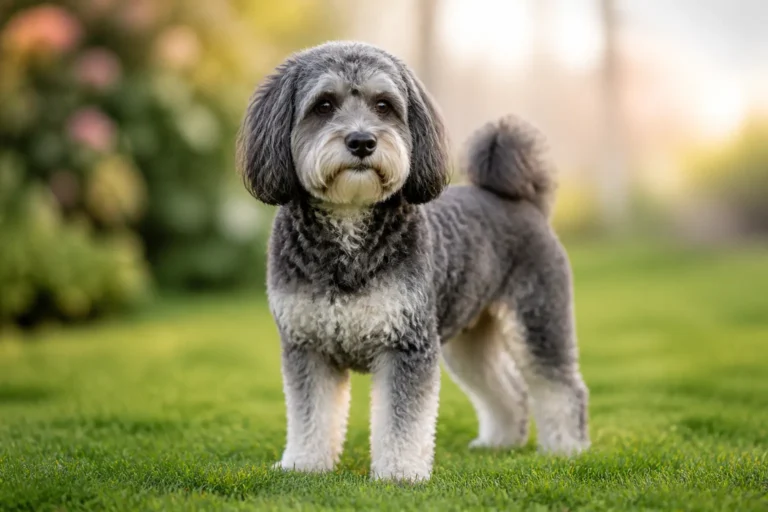
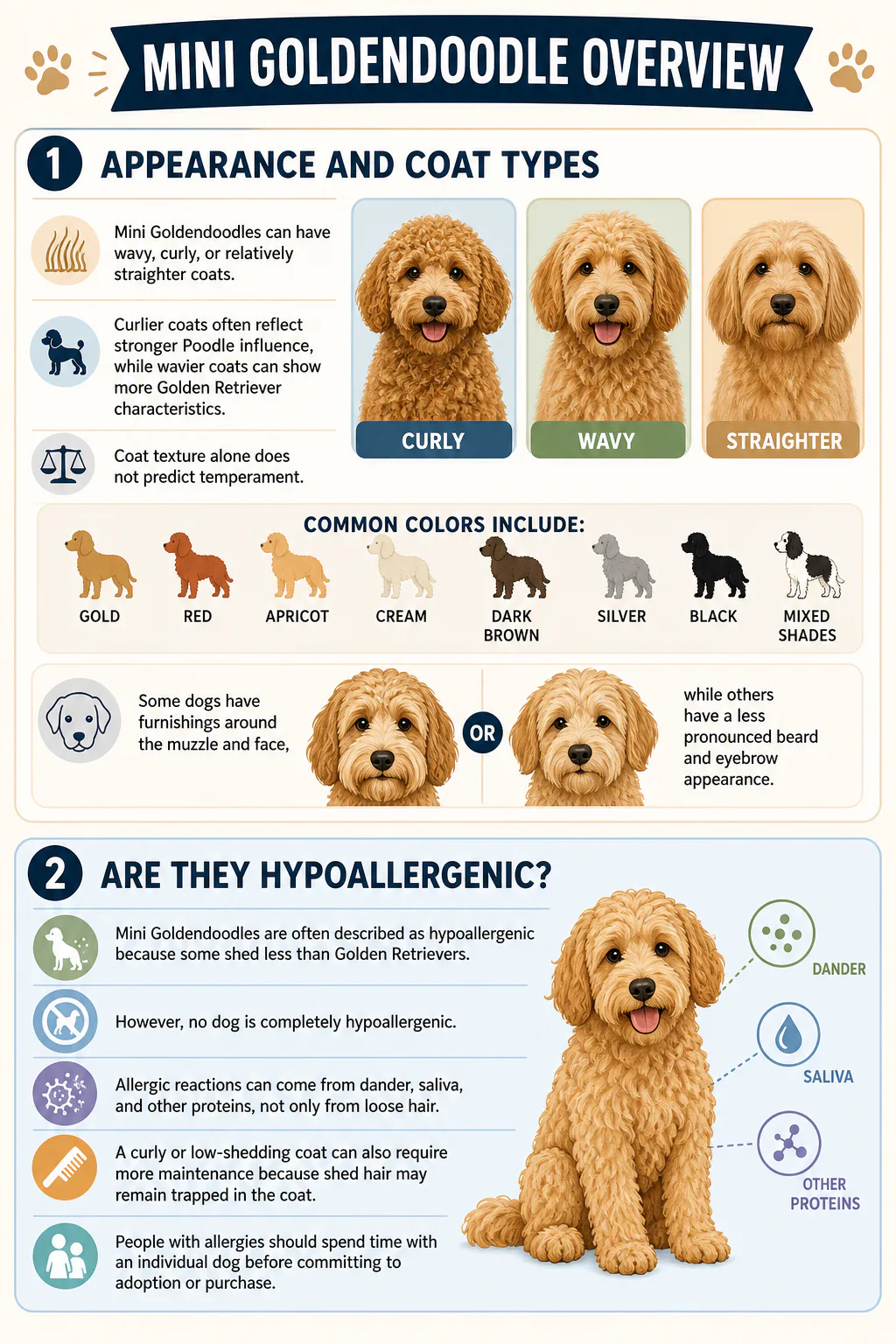
Mini Goldendoodles can have wavy, curly, or relatively straighter coats. Curlier coats often reflect stronger Poodle influence, while wavier coats can show more Golden Retriever characteristics. Coat texture alone does not predict temperament.
Common colors include gold, red, apricot, cream, dark brown, silver, black, and mixed shades. Some dogs have furnishings around the muzzle and face, while others have a less pronounced beard and eyebrow appearance.
Are They Hypoallergenic?
Mini Goldendoodles are often described as hypoallergenic because some shed less than Golden Retrievers. However, no dog is completely hypoallergenic. Allergic reactions can come from dander, saliva, and other proteins, not only from loose hair.
A curly or low-shedding coat can also require more maintenance because shed hair may remain trapped in the coat. People with allergies should spend time with an individual dog before committing to adoption or purchase.
Temperament and Behavior
The typical Mini Goldendoodle is friendly, affectionate, playful, and eager to interact with people. Golden Retrievers contribute a cooperative, family-focused nature, while Miniature Poodles are known for intelligence and trainability.
These qualities do not eliminate the need for early socialization. Puppies should gradually encounter household sounds, visitors, handling, other appropriate dogs, and new environments in positive ways.
Do Mini Goldendoodles Bark a Lot?
Mini Goldendoodles can bark to alert their owners, express excitement, seek attention, or respond to unfamiliar sounds. Some bark frequently, while others are comparatively quiet. Training, daily activity, separation habits, genetics, and the home environment all influence barking.
Reward-based training can teach a dog when to settle and redirect attention-seeking behavior. Punishment may increase anxiety and does not address the reason for the barking.
Energy Level and Exercise
Mini Goldendoodles generally have a moderate energy level, though puppies and adolescent dogs often need considerably more activity than mature adults. A suitable routine can include walks, active play, short training sessions, and supervised opportunities to explore.
Mental stimulation is important because both parent breeds are intelligent. Food puzzles, scent games, retrieving exercises, trick training, and basic obedience can help prevent boredom without relying solely on longer walks.
- Provide daily physical activity suited to the dog’s age and fitness.
- Use short, consistent training sessions rather than demanding long drills.
- Teach calm behavior, settling, and polite greetings.
- Increase exercise gradually as a puppy grows.
- Allow regular rest, especially after active play or training.

Training and Socialization
Mini Goldendoodles often respond well to positive reinforcement because they are social and motivated by interaction, food, toys, or praise. Clear household rules should be established from the beginning and applied consistently by every member of the family.
Early training should cover name recognition, recall, leash manners, crate or rest-area comfort, handling, and appropriate chewing. Socialization should focus on calm, positive experiences rather than forcing a puppy to interact with every person or dog.
Some Mini Goldendoodles become distressed when left alone because they form close attachments to their families. Gradual alone-time training can help build independence and should begin with short, manageable absences.
Grooming Requirements
Grooming needs depend heavily on coat length, curl, density, and the dog’s lifestyle. Regular brushing helps reduce mats, particularly behind the ears, under the legs, around the collar, and near the tail.
Professional grooming is commonly part of Mini Goldendoodle ownership. The groomer may trim the coat, clean sensitive areas, clip nails, and check for tangles. Ear care is also important because a floppy ear and dense hair can reduce airflow and allow moisture to remain inside the ear.
- Brush thoroughly rather than brushing only the visible top layer.
- Check ears, paws, armpits, and the collar area for tangles.
- Keep nails at a comfortable length.
- Introduce bathing, brushing, and grooming tools gradually.
- Ask a veterinarian about an appropriate ear-cleaning routine.
Health and Lifespan
The Mini Goldendoodle lifespan is commonly described as 11–14 years. Longevity depends on inherited traits, preventive veterinary care, nutrition, weight management, dental care, activity, and the dog’s living conditions.
Potential health concerns can come from either parent breed. Responsible breeding programs evaluate breeding dogs for relevant orthopedic, eye, heart, and inherited conditions, but health testing reduces risk rather than guaranteeing that every puppy will remain free of disease.
Routine veterinary care should include vaccinations, parasite prevention, dental assessment, weight monitoring, and age-appropriate screening. Owners should also seek veterinary advice for persistent itching, lameness, digestive changes, unusual fatigue, or changes in behavior.
F1 and F1B Mini Goldendoodles
F1 Generation
An F1 Mini Goldendoodle is generally the first-generation cross between a Golden Retriever and a Miniature Poodle. F1 dogs can have a broad range of coat textures and shedding levels because their genetic contribution comes directly from two different breeds.
F1B Generation
An F1B Mini Goldendoodle is commonly produced by crossing an F1 Goldendoodle with a Miniature Poodle. This adds more Poodle influence and often produces a curlier, lower-shedding coat, although individual results are not guaranteed.
Generation labels should not replace an evaluation of the parents, puppy health records, temperament, socialization practices, and breeding environment. A label alone cannot promise a specific adult appearance or behavior.
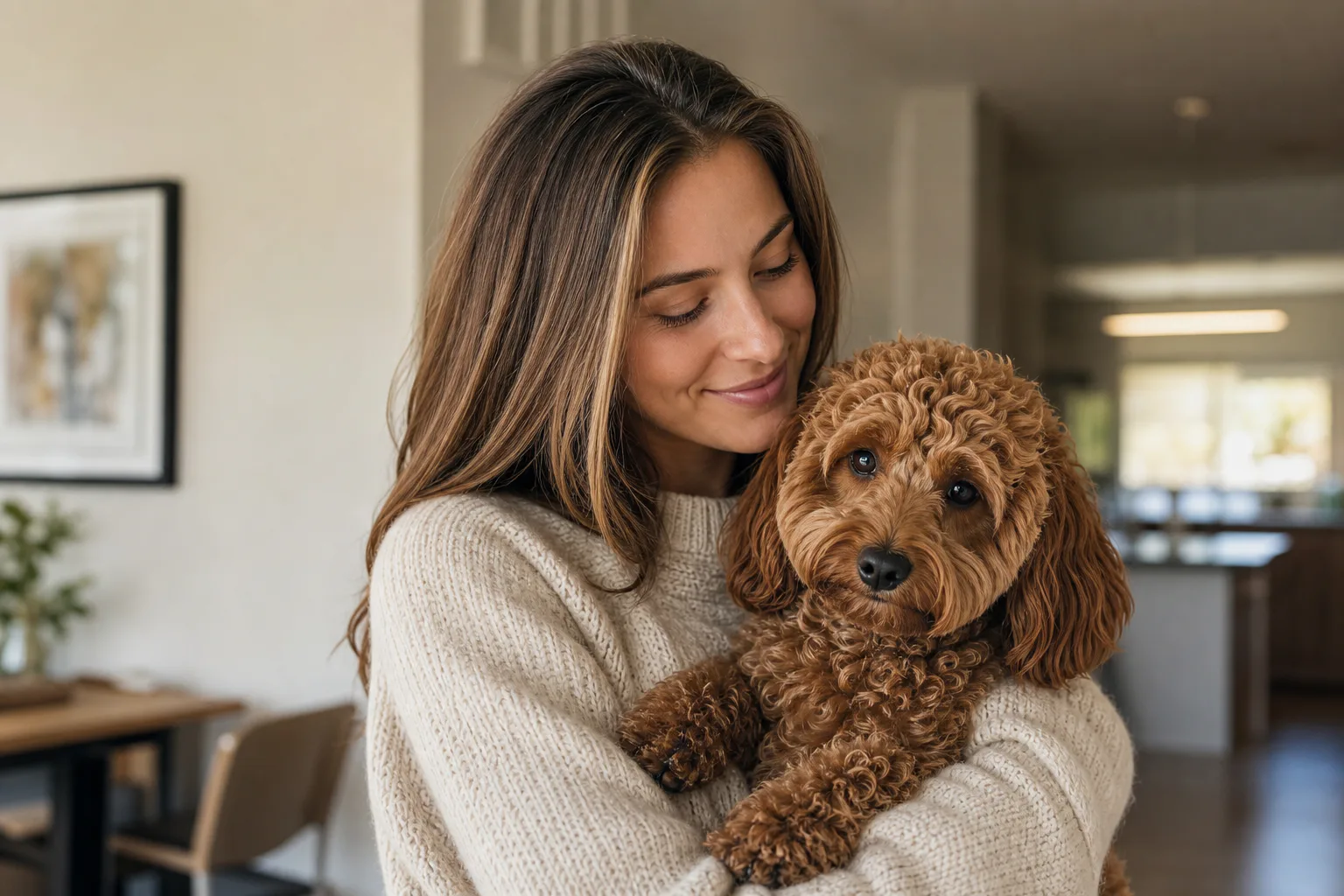
Pros and Cons
| Potential advantages | Potential challenges |
|---|---|
| Affectionate and socially oriented | Can struggle with extended isolation |
| Often responsive to training | Intelligence can contribute to boredom or mischief |
| Smaller than a Standard Goldendoodle | Adult size and coat traits are not perfectly predictable |
| May shed less than a Golden Retriever | Still not reliably hypoallergenic |
| Can adapt well to many households | Regular grooming and exercise remain necessary |
Is a Mini Goldendoodle a Good Family Dog?
A Mini Goldendoodle can be a strong choice for a family that wants an affectionate, trainable companion and can provide daily attention. The dog’s moderate activity level and adaptable nature can suit different home settings, provided exercise, enrichment, and toilet-training needs are handled consistently.
Families with young children should supervise all interactions. Children need instruction on gentle handling, respecting the dog’s resting space, and avoiding rough play or attempts to take food and toys.
A Mini Goldendoodle may be less suitable for a household seeking a very independent dog, a guaranteed non-shedding coat, or a pet that needs little grooming. The best match depends on the individual dog’s temperament as well as the family’s schedule.
Choosing a Mini Goldendoodle
When considering a Mini Goldendoodle for sale, focus on health, temperament, and care practices rather than coat color or marketing language. Meet the mother when possible, ask about the father, review veterinary records, and observe whether the puppies are clean, alert, appropriately socialized, and comfortable with normal handling.
- Request health documentation for both parents.
- Ask how puppies are socialized and exposed to household life.
- Confirm vaccination, parasite-control, and veterinary-care records.
- Review the contract, return policy, and lifetime support.
- Be cautious of sellers who will not discuss parent health or allow questions.
- Choose temperament and welfare over rare colors or a promised coat type.
Frequently Asked Questions
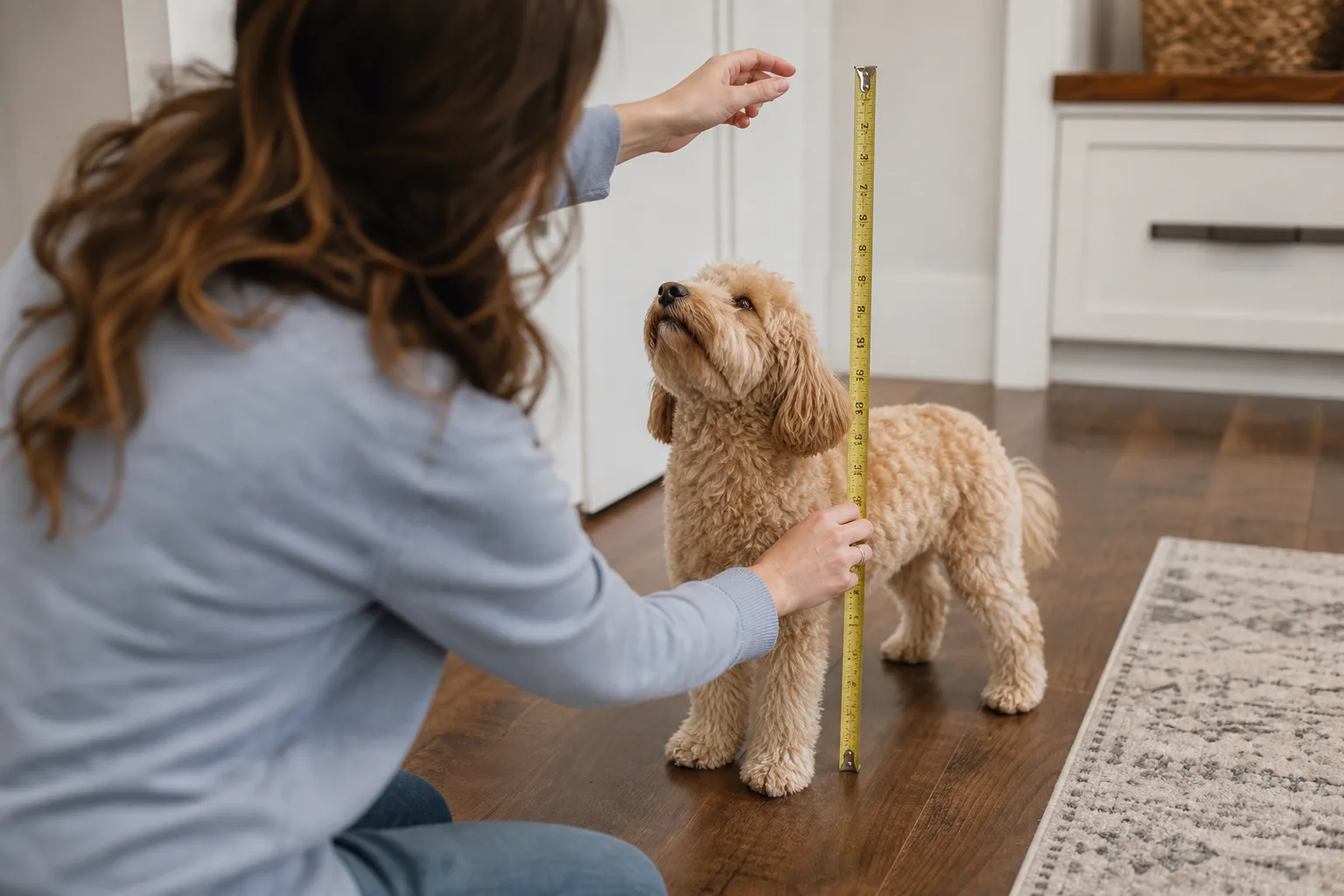
How big does a Mini Goldendoodle get?
There is no single adult size for every Mini Goldendoodle. These dogs are generally small to medium, but their final build depends on the size of the parents, generation, sex, and individual genetics.
Do Mini Goldendoodles shed?
Some Mini Goldendoodles shed lightly, while others shed more noticeably. Wavy and curly coats can reduce visible shedding, but coat type does not make a dog completely non-shedding.
How much exercise does a Mini Goldendoodle need?
Most need daily physical activity and mental stimulation. Walks, play, obedience work, retrieving, scent games, and food puzzles can all contribute to a balanced routine. Puppies need age-appropriate activity and plenty of rest.
Are Mini Goldendoodles easy to train?
Many are responsive to training because they are intelligent and people-oriented. Progress depends on consistent methods, early socialization, appropriate rewards, and the individual dog’s confidence and temperament.
Final Considerations
The Mini Goldendoodle is best understood as a variable hybrid rather than a precisely standardized breed. Its strongest qualities are usually its sociability, trainability, and adaptable companion temperament, while its main responsibilities include grooming, exercise, training, and careful attention to separation-related behavior.
Before choosing one, evaluate the individual puppy, the parents’ health information, and the breeder or rescue organization’s practices. A well-matched Mini Goldendoodle can become a rewarding family companion when its daily care needs fit the household.