Merrick Wet Pet Food Reviews: Ingredients, Nutrition & Value
Merrick wet pet food is a reasonable option for many dogs and cats because its recipes provide substantial moisture, named animal protein, and complete and balanced nutrition when the specific formula meets the appropriate AAFCO nutrient profile. Costs vary by line, many recipes are grain-free without that making them automatically healthier, palatability differs by pet, and Merrick has a documented recall history involving treats.
This review examines Merrick’s ingredients, guaranteed analysis, calorie content, recipe lines, manufacturing standards, daily feeding cost, customer experience, and suitability for different dogs and cats.
Merrick Wet Food: Quick Verdict
| Criterion | Assessment |
|---|---|
| Ingredient quality | Strong use of named meat, poultry, and fish, with animal protein prominent in many recipes |
| Nutrition | Several high-protein, moisture-rich formulas with complete and balanced options |
| Recipe variety | Good selection across Purrfect Bistro, Limited Ingredient Diet, Backcountry, and canned dog-food lines |
| Price | Moderate to high, with Backcountry costing more than the other cat-food lines |
| Manufacturing | Merrick states that most recipes are made in company-owned facilities in Hereford, Texas |
| Recall history | Past recalls involving treats reduce the brand’s overall safety score |
| Best fit | Pets that enjoy canned food and benefit from hydration, named proteins, or recipe variety |
Merrick is a reasonable brand to consider, but the label still matters more than the company name. Compare the formula’s AAFCO nutrient profile, life stages, calorie content, animal protein sources, and suitability for your pet’s medical or dietary needs before buying.
Merrick Wet Food Product Lines
Purrfect Bistro
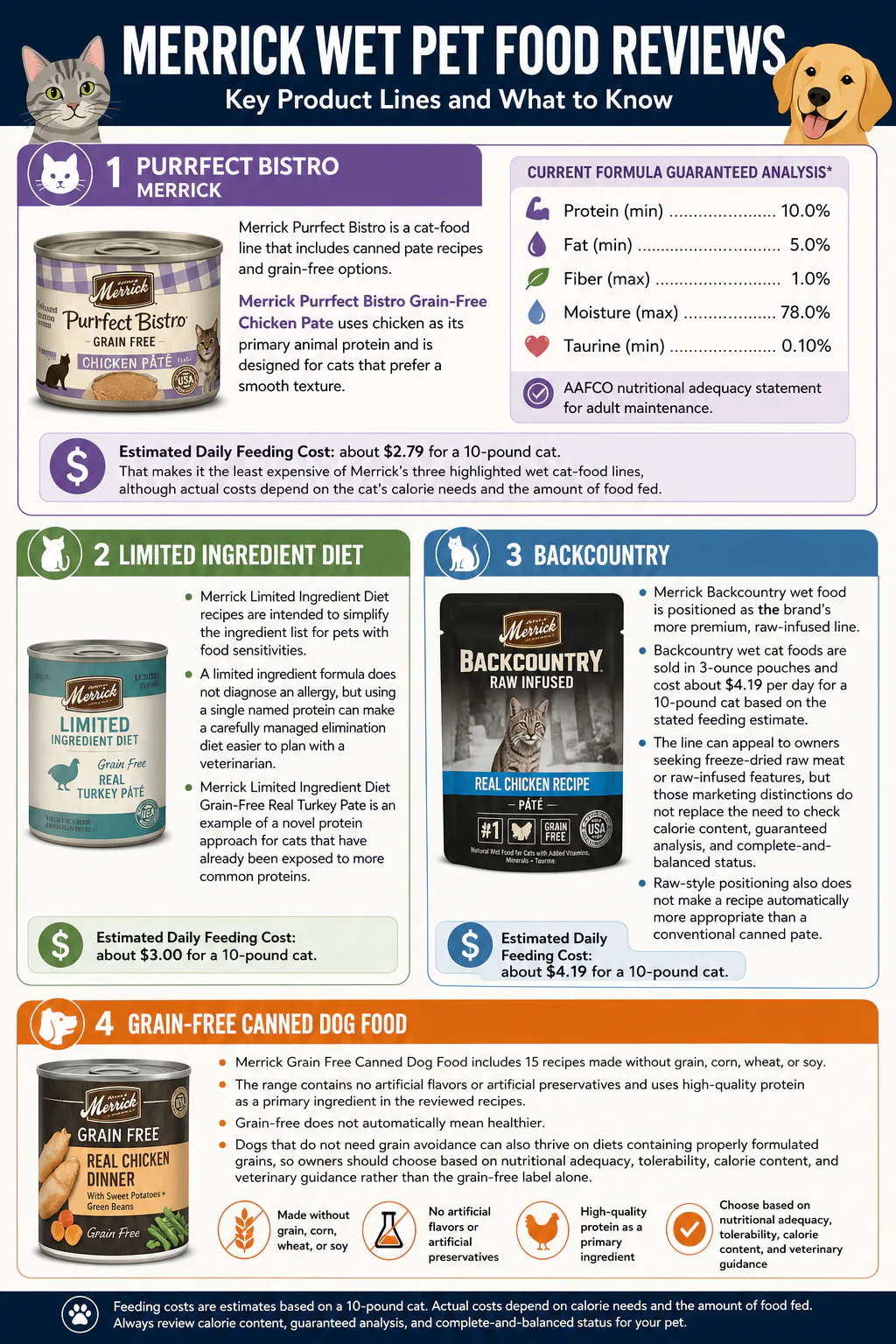
Merrick Purrfect Bistro is a cat-food line that includes canned pate recipes and grain-free options. Merrick Purrfect Bistro Grain-Free Chicken Pate uses chicken as its primary animal protein and is designed for cats that prefer a smooth texture.
Merrick Purrfect Bistro Grain-Free Chicken Pâté’s current formula label lists 10.0% minimum crude protein, 5.0% minimum crude fat, 1.0% maximum crude fiber, 78.0% maximum moisture, 0.10% minimum taurine, and an AAFCO nutritional adequacy statement for adult maintenance.
Purrfect Bistro canned food has an estimated daily feeding cost of about $2.79 for a 10-pound cat. That makes it the least expensive of Merrick’s three highlighted wet cat-food lines, although actual costs depend on the cat’s calorie needs and the amount of food fed.
Limited Ingredient Diet
Merrick Limited Ingredient Diet recipes are intended to simplify the ingredient list for pets with food sensitivities. A limited ingredient formula does not diagnose an allergy, but using a single named protein can make a carefully managed elimination diet easier to plan with a veterinarian.
Merrick Limited Ingredient Diet Grain-Free Real Turkey Pate is an example of a novel protein approach for cats that have already been exposed to more common proteins. The estimated daily feeding cost for a 10-pound cat is about $3.00.
Backcountry
Merrick Backcountry wet food is positioned as the brand’s more premium, raw-infused line. Backcountry wet cat foods are sold in 3-ounce pouches and cost about $4.19 per day for a 10-pound cat based on the stated feeding estimate.
The line can appeal to owners seeking freeze-dried raw meat or raw-infused features, but those marketing distinctions do not replace the need to check calorie content, guaranteed analysis, and complete-and-balanced status. Raw-style positioning also does not make a recipe automatically more appropriate than a conventional canned pate.
Grain-Free Canned Dog Food
Merrick Grain Free Canned Dog Food includes 15 recipes made without grain, corn, wheat, or soy. The range contains no artificial flavors or artificial preservatives and uses high-quality protein as a primary ingredient in the reviewed recipes.
Grain-free does not automatically mean healthier. Dogs that do not need grain avoidance can also thrive on diets containing properly formulated grains, so owners should choose based on nutritional adequacy, tolerability, calorie content, and veterinary guidance rather than the grain-free label alone.
Ingredient and Nutrition Analysis
Merrick’s wet recipes often begin with named meat such as deboned chicken, turkey, beef, or fish. Named animal protein gives the buyer more information than a vague ingredient such as “meat,” although ingredient order alone does not prove the overall quality of a food.
The Merrick Grain Free Real Chicken Wet Dog Food recipe lists deboned chicken, chicken broth, chicken liver, dried egg product, and natural flavor among its first ingredients. It also includes salmon oil, which supplies fish-derived fatty acids, along with functional ingredients such as taurine and added vitamins and minerals.
Broth contributes moisture and palatability, while liver and dried egg product add animal-derived nutrients. Other Merrick recipes use ingredients such as potatoes, carrots, apples, peas, agar agar, guar gum, and locust bean gum. Gums are used to stabilize texture and do not automatically make a food nutritionally poor, although individual pets can respond differently to any ingredient.
Reading the guaranteed analysis
Wet food labels can make protein and fat appear lower than they are because moisture dilutes the listed percentages. To compare canned food with dry food, convert the guaranteed analysis to a dry matter basis by removing the moisture portion from the calculation.
- Crude protein: the minimum percentage of protein in the recipe.
- Crude fat: the minimum percentage of fat.
- Crude fiber: the maximum amount of fiber.
- Moisture: the maximum water content.
- Calorie content: the energy supplied per can, pouch, or measured serving.
Merrick Grain Free Grammy’s Pot Pie lists deboned chicken as its first ingredient. Its guaranteed analysis lists at least 8% crude protein, at least 4% crude fat, and no more than 78% moisture. On a dry matter basis, the recipe contains approximately 44% protein, 22% fat, and 25% carbohydrates.
Across the analyzed Merrick canned recipes, protein averages 42.5% and fat averages 23.2% on a dry matter basis. These are range averages, not guaranteed values for every can.
Merrick Grain Free Real Chicken Wet Dog Food lists 9% minimum crude protein, 7% minimum crude fat, 1.4% maximum crude fiber, and 78% maximum moisture. Its listed calorie calculation provides 442 kcal per can, making portion control important for small or less active dogs.
Top Merrick Wet Recipes Reviewed
| Recipe | Pet | Format | Key nutrition or cost detail | Best use |
|---|---|---|---|---|
| Grain Free Grammy’s Pot Pie | Dog | Canned food | 8% minimum crude protein, 4% minimum crude fat, 78% maximum moisture; approximately 44% protein and 22% fat on a dry matter basis | Dogs that enjoy a chicken-based, gravy-style recipe |
| Grain Free Real Chicken Wet Dog Food | Dog | Canned food | 9% minimum crude protein, 7% minimum crude fat, 1.4% maximum crude fiber, 78% maximum moisture, 442 kcal per can | Dogs needing a moisture-rich chicken recipe with clearly named animal ingredients |
| Purrfect Bistro Grain-Free Chicken Pate | Cat | Canned pate | Estimated daily cost of $2.79 for a 10-pound cat | Cats that prefer a smooth pate and chicken-based food |
| Limited Ingredient Diet Grain-Free Real Turkey Pate | Cat | Canned pate | Estimated daily cost of $3.00 for a 10-pound cat | Cats needing a simplified, turkey-based ingredient profile |
| Backcountry wet cat food | Cat | 3-ounce pouch | Estimated daily cost of $4.19 for a 10-pound cat | Owners seeking a premium pouch format and raw-infused positioning |
The 15-recipe Merrick grain-free canned dog-food range has recipe ratings ranging from 3.5 to 5 stars. Because fat, calories, texture, and protein sources differ by recipe, evaluate the specific can rather than relying on a range-level rating.
Pros and Cons
Advantages
- Many recipes feature named meat or other clearly identified animal protein.
- High moisture supports hydration, which is useful for pets that drink little water.
- The brand offers canned dog food, canned cat food, pate, pouches, limited-ingredient recipes, and raw-infused options.
- Several recipes provide high crude protein on a dry matter basis.
- Merrick states that its foods avoid artificial flavors, artificial preservatives, sweeteners, and colorings.
- The company states that it does not source ingredients from China.
- Most wet and dry dog foods are produced in the United States at company-owned facilities.
Drawbacks
- Backcountry wet cat food has a higher estimated daily feeding cost than Purrfect Bistro or Limited Ingredient Diet.
- Many recipes are grain-free, which is not automatically an advantage for every dog or cat.
- Rich, high-fat recipes may not suit pets that require a lower-fat diet.
- Some pets reject particular textures or flavors despite a strong ingredient profile.
- Merrick has a documented recall history involving treats.
- Ingredient suitability depends on the individual pet’s allergies, health status, age, and calorie needs.
Owners comparing food costs should calculate the daily feeding cost rather than comparing can prices alone. A food with a higher price per can can have a different calorie density, while a lower-priced recipe may require more cans to meet a pet’s energy needs.
Recalls, Manufacturing, and Sourcing
Merrick Pet Care was founded by Garth Merrick and his family in 1988 in Hereford, Texas. Nestlé Purina PetCare announced its acquisition of Merrick in 2015. Merrick states that its foods are prepared in company-owned kitchens in Hereford and that its facilities are Safe Quality Food Level 3-certified and certified by the USDA National Organic Program.
Merrick also owns its own cannery and states that its wet and dry dog foods are produced in the United States, with most recipes manufactured at one of three company-owned facilities in Hereford, Texas. The company describes its sourcing program as using local growers in some cases and states that ingredients are not sourced from China.
These manufacturing and sourcing policies provide useful transparency, but they do not eliminate the need to monitor current product notices. A company’s facility standards are one part of evaluating food; formulation, quality control, storage, handling, and the individual pet’s response also matter.
Documented recall history
- May 2018: beef-based dog treats were recalled over potentially elevated beef thyroid hormones.
- January 2011: Jr. Texas Taffy treats were recalled over potential Salmonella contamination.
- Summer 2011: Merrick Doggie Wishbone treats were recalled over potential Salmonella contamination.
- 2010: Merrick treats were recalled over possible Salmonella contamination.
Merrick wet dog food and cat food have no current recalls as of August 2026.
The documented events above involved treats rather than the canned recipes discussed here, but they remain part of Merrick’s recall history. A cat-food evaluation scored Merrick 6.3 out of 10 overall, with 8 out of 10 for ingredient quality and 4 out of 10 for recall history. Readers who compare brands should also understand how pet food recalls can affect purchasing decisions beyond a single product line.
What Customers and Pets Think
Customer experiences with Merrick wet food are mixed in the way expected from a broad product range. Positive reports focus on palatability, moisture, ingredient transparency, and improved acceptance by pets that reject dry food.
Other reports describe cats or dogs refusing a particular flavor, disliking a pate texture, or experiencing digestive upset after a diet change. Complaints also include concerns about foreign objects or changes in texture, but an individual report does not establish a confirmed manufacturing defect.
Palatability is especially important with canned food because a nutritionally suitable recipe has little value if the pet will not eat it. Introduce a new food gradually, keep the old food available during the transition when appropriate, and stop feeding a product if your pet develops persistent vomiting, diarrhea, facial swelling, breathing difficulty, or other concerning symptoms.
Pets with food sensitivities should not be switched among multiple proteins casually. A veterinarian can determine whether a limited-ingredient or novel-protein trial is appropriate and can help distinguish an adverse food reaction from a separate gastrointestinal or skin condition.
Choosing Merrick for Dogs
Is Merrick wet food good for dogs? It can be, particularly for dogs that need hydration, prefer canned food, or do well with named animal proteins. The Merrick Grain Free Canned Dog Food recipes reviewed here contain no grain, corn, wheat, or soy, but grain avoidance should be based on the dog’s needs rather than treated as a universal nutritional improvement.
Check that the specific can states it is complete and balanced for your dog’s life stages. Puppies, adult dogs, seniors, pregnant dogs, and dogs with conditions such as pancreatitis, kidney disease, or obesity can require different nutrient targets.
Do vets recommend Merrick dog food? Veterinarians do not recommend one brand for every dog. A veterinarian may consider a Merrick recipe when its nutrient profile, calorie content, ingredients, and feeding format match the dog’s health needs, but a brand label alone is not proof that a formula is suitable.
For owners managing an ongoing pet-care budget, food is only one recurring expense. Medical planning, preventive care, and insurance for dogs can also affect the total cost of caring for a dog, especially when dietary needs change after diagnosis.
Choosing Merrick for Cats
Merrick’s cat-food lines provide several ways to prioritize moisture and animal protein. Purrfect Bistro is the lower-cost option among the highlighted lines, Limited Ingredient Diet offers a simpler protein focus, and Backcountry provides a pouch format with raw-infused positioning at a higher daily cost.
Merrick’s cat-food evaluation score is 6.3 out of 10 overall, including 8 out of 10 for ingredient quality and 4 out of 10 for recall history. Those figures support a balanced view: ingredient strengths do not erase the importance of documented past events.
For cats, texture can be as important as flavor. A cat that prefers pate may reject a pouch, while another may prefer food with more visible pieces or gravy. Buy a small quantity first when possible, and confirm that the recipe is complete and balanced rather than intended only as a supplemental food.
Frequently Asked Questions
Is Merrick dog food high quality?
Merrick offers several high-quality wet dog-food recipes with named animal protein, substantial moisture, and useful dry matter nutrition. Quality still varies by formula, so compare the guaranteed analysis, calorie content, AAFCO nutrient profile, fat level, and ingredient suitability for your dog.
What is the healthiest brand of wet dog food?
There is no single healthiest brand for every dog. The best choice is a complete and balanced wet food that fits the dog’s life stage, medical needs, calorie target, dietary tolerance, and feeding preferences.
Is grain-free Merrick food automatically healthier?
No. Grain-free food excludes grains, but grain-free is not automatically healthier. Dogs without a specific reason to avoid grains can do well on either grain-inclusive or grain-free diets when the recipe is nutritionally complete and appropriately formulated.
Does Merrick wet food contain artificial preservatives?
Merrick states that its foods avoid artificial preservatives, artificial flavors, sweeteners, and colorings. Check the current package label because formulations and product availability can change.
Is Merrick cat food discontinued?
Merrick offers wet cat food through Purrfect Bistro, Limited Ingredient Diet, and Backcountry. Individual flavors, package sizes, or retail listings can change, so verify the specific recipe and its complete-and-balanced statement before making a replacement choice.
Can wet food help my pet stay hydrated?
Yes. Wet food contains substantially more moisture than dry food and can increase daily water intake through meals. It does not replace veterinary treatment for dehydration or urinary, kidney, or other medical conditions.
Is Merrick Wet Food Worth Buying?
Merrick wet food is worth considering for owners who value named animal protein, hydration, recipe variety, and U.S. manufacturing claims. Purrfect Bistro offers the strongest value among the highlighted cat lines, Limited Ingredient Diet is the more targeted option for a simplified protein approach, and Backcountry suits buyers willing to pay more for pouches and raw-infused positioning.
For dogs, the canned range provides several protein-rich choices, including Grammy’s Pot Pie and Real Chicken Wet Dog Food. Choose the specific recipe based on its guaranteed analysis, dry matter nutrition, calorie content, life-stage statement, and your pet’s response, then discuss any therapeutic or elimination diet with a veterinarian.
The practical next step is to compare one or two Merrick recipes with your pet’s current food, calculate the daily feeding cost, and transition gradually. Owners tracking age-related nutrition changes can also use a dog age calculator as a general planning tool, while relying on veterinary advice for precise life-stage and health decisions.