Pet Insurance for Dogs: Coverage, Costs, and Policy Tips

A serious illness or accident can turn a routine day with your dog into a major financial decision. Pet insurance for dogs helps manage eligible veterinary expenses by reimbursing you after covered treatment, but the value depends on the policy’s exclusions, limits, deductible, and reimbursement rules.
The right plan is not necessarily the one with the lowest premium. This guide explains what dog insurance covers, what it excludes, how claims work, what affects cost, and how to compare policies before enrolling.
How dog insurance works
Most dog insurance policies require you to pay the veterinarian directly and then submit a claim. The insurer reimburses a percentage of eligible expenses after applying the deductible and any policy limits.
For example, a policy could have an annual deductible, an 80% reimbursement rate, and a maximum annual benefit. The exact calculation depends on whether the deductible applies before or after reimbursement and whether the insurer uses the full invoice or an eligible-cost schedule.
Key policy terms
- Premium: The recurring amount you pay to keep the policy active.
- Deductible: The amount you pay for eligible care before reimbursement begins. It may be annual or apply separately to each condition.
- Reimbursement rate: The percentage of eligible costs the insurer pays after the deductible.
- Annual limit: The maximum the policy pays during a policy year.
- Lifetime limit: The maximum payable over the dog’s life, if the policy includes one.
- Waiting period: The time between enrollment and the start of coverage for certain accidents or illnesses.
- Pre-existing condition: An illness, injury, symptom, or related condition that began or showed signs before coverage started or during a waiting period.

What dog insurance can cover
Coverage varies by insurer and plan. Accident and illness policies commonly address unexpected veterinary treatment, while optional wellness coverage can help with routine care.
Accident coverage
Accident coverage can apply to eligible treatment for events such as injuries, foreign-object ingestion, wounds, or fractures. It is generally less comprehensive than accident and illness coverage because it does not cover conditions that arise from sickness.
Illness coverage
Accident and illness plans can cover eligible care for newly diagnosed conditions, such as infections, digestive disorders, allergies, or cancer. Policies may cover examinations, diagnostic testing, surgery, hospitalization, prescription medication, and specialist care when those services are included and medically necessary.
Routine-care add-ons
Some insurers offer wellness or preventive-care packages for services such as vaccinations, parasite prevention, dental cleanings, or wellness examinations. These benefits usually have defined allowances rather than unlimited reimbursement, so compare the package’s cost with the routine expenses you already expect.
What policies usually exclude
Insurance is designed to cover eligible future expenses, not bills that already exist. Pre-existing conditions are commonly excluded, and a condition that appears during a waiting period can also be excluded under the policy terms.
- Pre-existing illnesses, injuries, and related symptoms
- Routine care under plans without wellness benefits
- Cosmetic procedures and elective treatment
- Breeding, pregnancy, or birth-related costs under many policies
- Some hereditary, congenital, dental, behavioral, or alternative treatments
- Services excluded by a plan’s limits, definitions, or medical-necessity rules
Read the sample policy and definitions before buying. Marketing pages can describe broad coverage, while the contract determines exclusions, condition classifications, bilateral-condition rules, claim deadlines, and renewal terms.

Choosing the right coverage
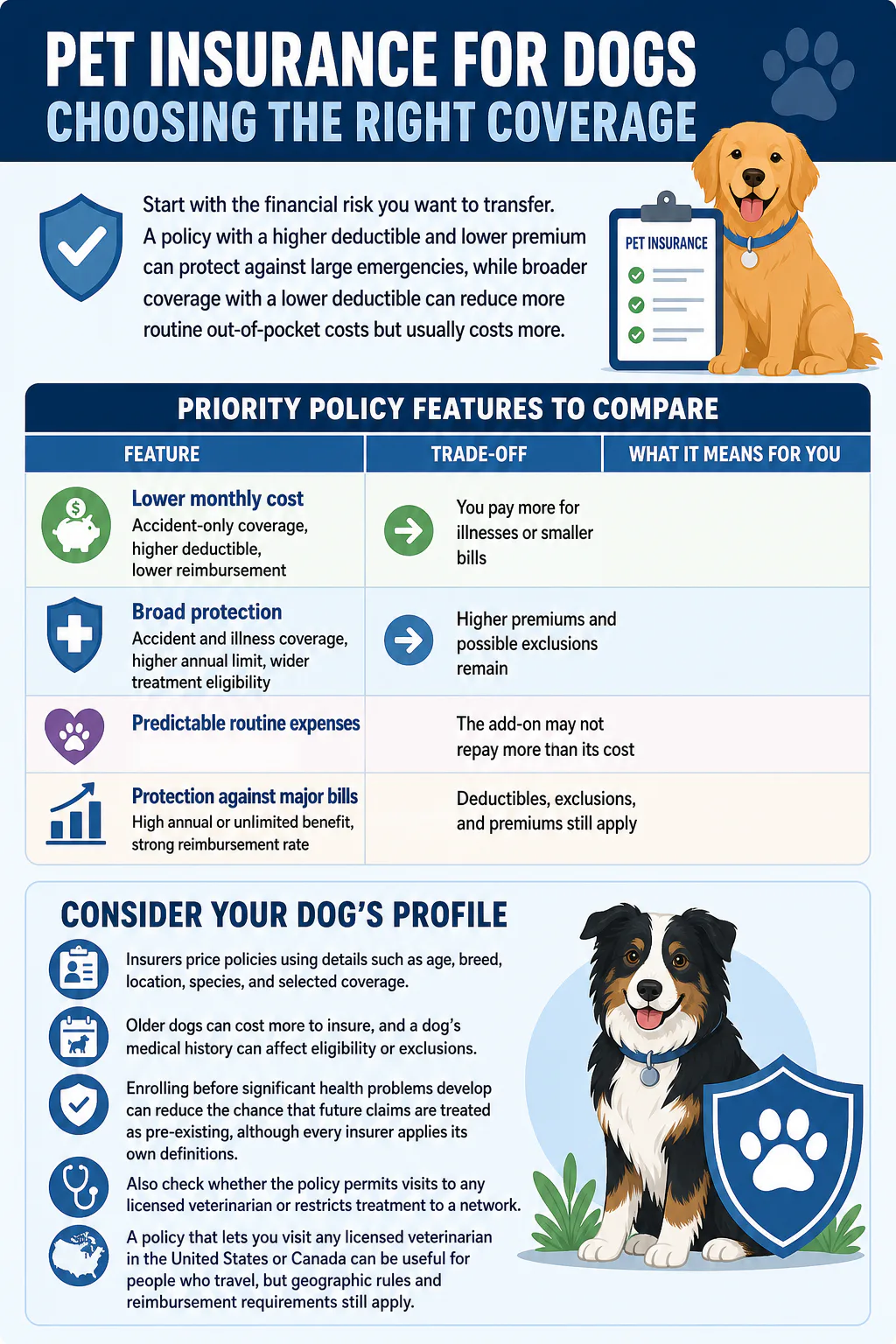
Start with the financial risk you want to transfer. A policy with a higher deductible and lower premium can protect against large emergencies, while broader coverage with a lower deductible can reduce more routine out-of-pocket costs but usually costs more.
| Priority | Policy features to compare | Trade-off |
|---|---|---|
| Lower monthly cost | Accident-only coverage, higher deductible, lower reimbursement | You pay more for illnesses or smaller bills |
| Broad protection | Accident and illness coverage, higher annual limit, wider treatment eligibility | Higher premiums and possible exclusions remain |
| Predictable routine expenses | Wellness add-on with stated preventive-care allowances | The add-on may not repay more than its cost |
| Protection against major bills | High annual or unlimited benefit, strong reimbursement rate | Deductibles, exclusions, and premiums still apply |
Consider your dog’s profile
Insurers price policies using details such as age, breed, location, species, and selected coverage. Older dogs can cost more to insure, and a dog’s medical history can affect eligibility or exclusions. Enrolling before significant health problems develop can reduce the chance that future claims are treated as pre-existing, although every insurer applies its own definitions.
Also check whether the policy permits visits to any licensed veterinarian or restricts treatment to a network. A policy that lets you visit any licensed veterinarian in the United States or Canada can be useful for people who travel, but geographic rules and reimbursement requirements still apply.
How much does dog insurance cost?
There is no single average price that applies to every dog. Premiums depend on the dog’s age, breed, location, medical history, coverage level, deductible, reimbursement rate, and annual limit.
Accident-only coverage can be substantially less expensive than accident and illness coverage. One advertised example lists an accident-only plan at $9 per month for dogs, but that figure is not an average and does not represent the cost of broader coverage or every dog’s quote.
Get quotes using identical settings when comparing insurers. A low premium can reflect a high deductible, a low annual limit, narrower coverage, or exclusions that reduce the policy’s practical value.
Questions to ask about price
- Can the premium increase at renewal, and what factors affect an increase?
- Is the deductible annual, per condition, or per incident?
- Does the reimbursement rate apply after the deductible?
- Are exam fees included or excluded?
- Are prescription drugs, diagnostic tests, rehabilitation, and specialist care covered?
- Are there annual, lifetime, per-condition, or category-specific limits?
Is pet insurance worth it?
Pet insurance can be worthwhile if an unexpected veterinary bill would force you to delay treatment, borrow money, or use savings needed for essential expenses. It can also make treatment decisions less dependent on the amount of cash available at the time of an emergency.
Insurance is less compelling for owners who can comfortably maintain a dedicated emergency fund and accept the risk of paying all veterinary expenses themselves. Premiums are paid whether or not you file a claim, and a policy may exclude conditions your dog already has.
A practical decision test is to compare the annual premium and deductible with the emergency reserve you could maintain. Choose insurance if transferring the risk of a large eligible bill matters more to you than keeping the premium available for savings.
What do veterinarians recommend?
Veterinarians do not recommend one universal insurer for every dog. Their clinical role is to recommend appropriate treatment, while the policy determines whether that treatment is covered and how much you receive.
A veterinarian can help you understand likely care needs for your dog’s age, breed, or existing diagnosis. Ask the insurer for written answers about exclusions and submit the medical-record requirements before assuming a particular treatment will be reimbursed.

Can you get free dog insurance?
Free, comprehensive insurance for dogs is not generally available as a standard consumer product. Some adoption organizations, shelters, employers, membership groups, or promotional programs provide temporary coverage or financial assistance, but these offers can have narrow eligibility requirements and limited benefits.
For households with limited income, ask local shelters, veterinary hospitals, animal welfare organizations, and community clinics about payment plans, charitable funds, and lower-cost preventive services. These resources are assistance programs, not substitutes for reviewing an insurance contract.
Popular search questions
Does pet insurance cover everything?
No. Every policy has exclusions, waiting periods, deductibles, reimbursement rules, and payment limits. A policy marketed as comprehensive still may not cover pre-existing conditions, elective care, certain dental services, breeding, or treatment outside the contract’s definitions.
Can you use insurance at any veterinarian?
Many reimbursement-based policies allow you to visit a licensed veterinarian rather than requiring a specific network. Confirm the policy’s geographic restrictions, license requirements, referral rules, and claim documentation before enrolling.

Is direct payment to the veterinarian available?
Some insurers offer direct payment arrangements in specific circumstances, but reimbursement to the policyholder is common. Confirm whether you must pay the full bill first and how quickly claims are processed under the policy.
Should you insure a puppy?
Insuring a puppy can provide protection before a long medical history develops, but you should compare waiting periods, hereditary and congenital exclusions, coverage limits, and premium changes. A puppy policy is not automatically better than building savings, so base the decision on your budget and tolerance for veterinary risk.
How to compare policies
- Request quotes using the same dog details and coverage settings.
- Read the definitions of pre-existing, hereditary, congenital, bilateral, and curable conditions.
- Compare deductibles, reimbursement rates, annual limits, and lifetime limits.
- Check waiting periods for accidents, illnesses, orthopedic conditions, and other restricted treatments.
- Confirm whether exam fees, prescriptions, diagnostics, specialists, rehabilitation, and dental care are eligible.
- Review renewal terms, premium changes, cancellation rules, and claim deadlines.
- Ask how the insurer handles medical-record reviews and disputes about pre-existing conditions.
Bottom line
The strongest choice is a policy whose exclusions and payment rules you understand before your dog needs care. Compare plans using the same deductible, reimbursement rate, and annual limit, then choose coverage that protects your budget without creating a monthly payment you cannot sustain.
If you are uncertain, obtain several current quotes and read the sample policy rather than relying on a plan label alone. The best pet insurance for dogs is the policy that covers the risks you are most concerned about at a price you can maintain for the dog’s lifetime.