Top 10 Fresh Pet Dog Foods in the USA: Best Options Compared

Fresh dog food differs substantially in formulation, price, storage, recipe variety, and suitability for individual dogs. The ranking below compares 10 fresh, gently cooked, refrigerated, frozen, and shelf-stable dog food brands available in the USA, with attention to complete and balanced nutrition, AAFCO nutritional standards, veterinary expertise, food safety, convenience, and value.
Fresh food is not automatically healthier than every canned or dry diet. Check the nutritional adequacy statement, life-stage suitability, calorie information, storage requirements, and feeding instructions before changing your dog’s diet. Dogs with allergies, urinary disease, digestive disorders, obesity, or other medical needs should be evaluated by a veterinarian or board-certified veterinary nutritionist.
The 10 Best Fresh Dog Foods
| Rank | Brand | Best for | Format | Starting price or availability |
|---|---|---|---|---|
| 1 | The Farmer’s Dog | Personalized subscription meals | Fresh frozen | From $2.78 per day for small dogs |
| 2 | JustFoodForDogs | Recipe variety and veterinary-focused options | Fresh frozen and shelf-stable | From $1.91 per day for small dogs |
| 3 | Freshpet | Retail convenience and picky eaters | Refrigerated | From $1.48 per day for small dogs |
| 4 | Ollie | Personalized home delivery | Fresh frozen and other delivery formats | Check the current feeding plan |
| 5 | Nom Nom | Portioned fresh meals | Fresh frozen | Check the current feeding plan |
| 6 | PetPlate | Subscription meal plans and toppers | Fresh frozen | Check the current feeding plan |
| 7 | Stella & Chewy’s | Frozen and minimally processed choices | Frozen and shelf-stable formats | Varies by recipe and retailer |
| 8 | Purina | Accessible nutrition and broad distribution | Retail and veterinary diet formats | Varies by product |
| 9 | Hill’s | Veterinary and therapeutic nutrition | Retail and prescription formats | Varies by product |
| 10 | Royal Canin | Breed, size, life-stage, and prescription needs | Retail and prescription formats | Varies by product |
Quick Comparison
| Brand | Recipe variety | Convenience | Standout consideration |
|---|---|---|---|
| The Farmer’s Dog | Seven recipe options | Personalized home delivery and autoship | Completed a yearlong feeding study with Cornell University College of Veterinary Medicine |
| JustFoodForDogs | Six Fresh Frozen recipes and four JustFresh meals | Delivery, retail, and shelf-stable options | Includes recipes for sensitivities, joint support, and custom prescription diets |
| Freshpet | Up to five Freshpet Delivery recipes | Refrigerated retail products and delivery | Soft nugget-like pieces work in bowls, puzzle feeders, or as training rewards |
| Ollie | Personalized recipe selection | Subscription dog food delivered to the home | Useful for owners seeking portion guidance and scheduled delivery |
| Nom Nom | Fresh recipe selection | Pre-portioned home delivery | Designed around measured meals and feeding convenience |
| PetPlate | Fresh meals and topper choices | Subscription ordering | Can suit owners comparing full meals with meal-enhancing formats |
| Stella & Chewy’s | Multiple protein sources and formats | Retail purchasing | Provides an alternative to subscription-only fresh food |
| Purina | Broad product range | Widely distributed retail and veterinary channels | Strong option when accessibility and specialized nutrition matter |
| Hill’s | Retail and therapeutic diet range | Retail and veterinary purchasing | Particularly relevant for prescription diet discussions |
| Royal Canin | Size, breed, life-stage, and therapeutic formulas | Retail and veterinary channels | Useful when nutrient targets are more important than a fresh format |
Brand Reviews
1. The Farmer’s Dog
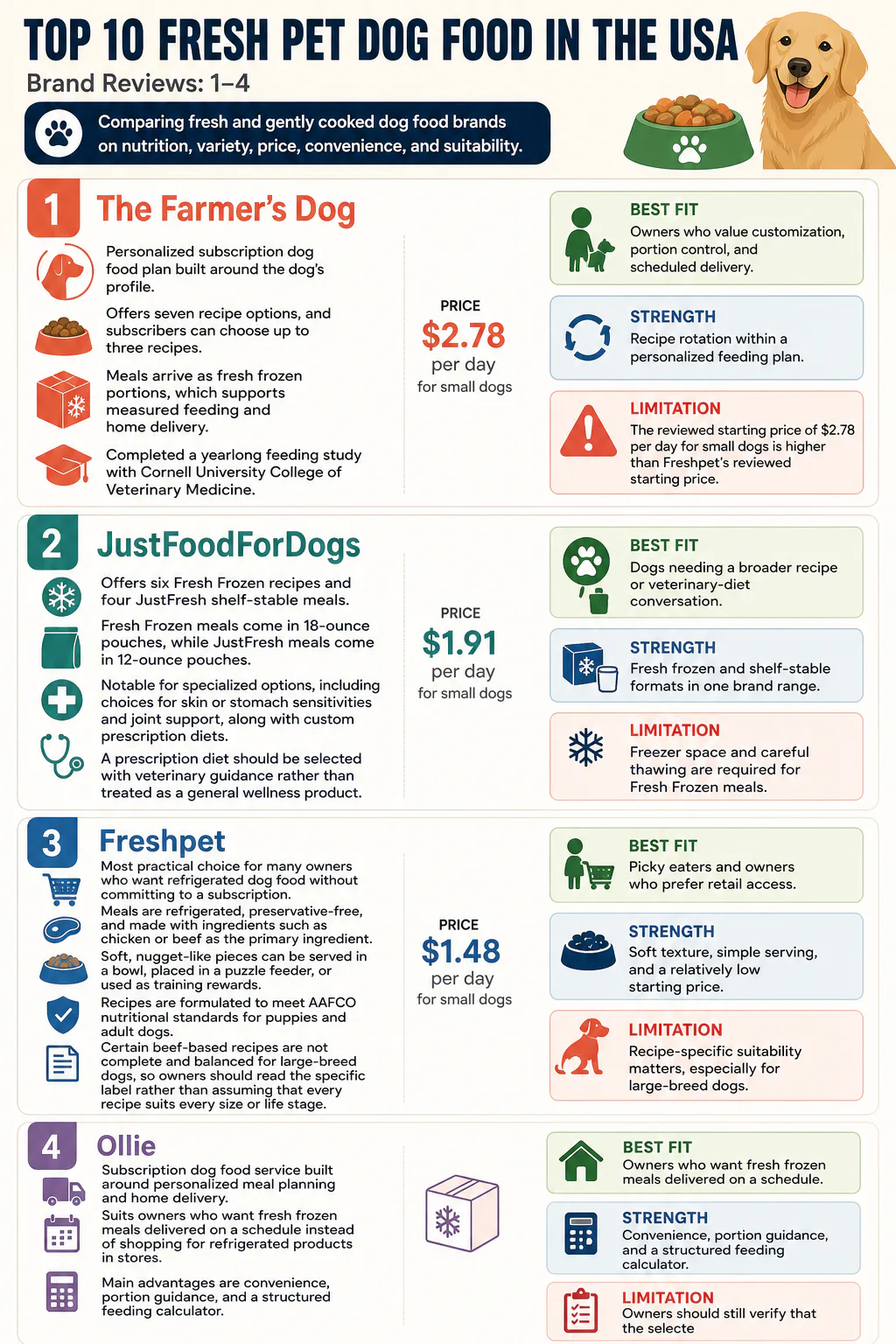
The Farmer’s Dog ranks first for owners who want a personalized subscription dog food plan built around the dog’s profile. It offers seven recipe options, and subscribers can choose up to three recipes. Meals arrive as fresh frozen portions, which supports measured feeding and home delivery. Pricing starts at $2.78 per day for small dogs.
The brand completed a yearlong feeding study with Cornell University College of Veterinary Medicine. That does not mean every recipe is appropriate for every dog, but it adds useful evidence to a category where marketing claims can exceed nutrition data.
- Best fit: Owners who value customization, portion control, and scheduled delivery.
- Strength: Recipe rotation within a personalized feeding plan.
- Limitation: The reviewed starting price of $2.78 per day for small dogs is higher than Freshpet’s reviewed starting price.
2. JustFoodForDogs
JustFoodForDogs offers six Fresh Frozen recipes and four JustFresh shelf-stable meals. Its Fresh Frozen meals come in 18-ounce pouches, while JustFresh meals come in 12-ounce pouches. This combination gives owners a choice between freezer storage and a more convenient shelf-stable format.
The brand is especially notable for specialized options. Its frozen recipes include choices for skin or stomach sensitivities and joint support, along with custom prescription diets. A prescription diet should be selected with veterinary guidance rather than treated as a general wellness product.
Prices start at $1.91 per day for small dogs. That makes JustFoodForDogs one of the stronger choices for shoppers who want fresh frozen food, specialized recipes, and a lower entry price than some personalized delivery plans.
- Best fit: Dogs needing a broader recipe or veterinary-diet conversation.
- Strength: Fresh frozen and shelf-stable formats in one brand range.
- Limitation: Freezer space and careful thawing are required for Fresh Frozen meals.
3. Freshpet
Freshpet is the most practical choice for many owners who want refrigerated dog food without committing to a subscription. Freshpet Delivery offers up to five fresh dog food recipes, while retail availability makes the brand easier to purchase during a normal shopping trip.
Freshpet describes its meals as refrigerated, preservative-free, and made with ingredients such as chicken or beef as the primary ingredient. Its soft, nugget-like pieces can be served in a bowl, placed in a puzzle feeder, or used as training rewards.
Freshpet recipes are formulated to meet AAFCO nutritional standards for puppies and adult dogs. Certain beef-based recipes are not complete and balanced for large-breed dogs, so owners should read the specific label rather than assuming that every recipe suits every size or life stage.
Prices start at $1.48 per day for small dogs. That is the lowest of the three researched daily starting prices in this comparison.
- Best fit: Picky eaters and owners who prefer retail access.
- Strength: Soft texture, simple serving, and a relatively low starting price.
- Limitation: Recipe-specific suitability matters, especially for large-breed dogs.
4. Ollie
Ollie is a subscription dog food service built around personalized meal planning and home delivery. It suits owners who want fresh frozen meals delivered on a schedule instead of shopping for refrigerated products in stores.
The main advantages are convenience, portion guidance, and a structured feeding calculator. Owners should still verify that the selected recipe is complete and balanced for the dog’s exact life stage, particularly when feeding a puppy, senior, pregnant dog, or dog with a diagnosed condition.
- Best fit: Households that prefer autoship and individualized portions.
- Strength: Delivery-centered meal planning.
- Limitation: Subscription cost, freezer capacity, and delivery timing need consideration.
5. Nom Nom
Nom Nom focuses on fresh frozen meals supplied in measured portions. That format can simplify calorie control and reduce the need to weigh large batches of food at every meal.
Nom Nom belongs on a shortlist for owners comparing fresh food delivery services, particularly when portion control and predictable home delivery are priorities. Compare the recipe’s nutritional adequacy statement, crude protein, calorie density, and feeding instructions with your veterinarian’s recommendations.
- Best fit: Owners who want measured fresh meals delivered to the home.
- Strength: Convenient portioning and routine delivery.
- Limitation: Frozen storage and delivery logistics can be less flexible than retail food.
6. PetPlate
PetPlate offers fresh frozen meals through a subscription model, with options that can be considered as complete meals or meal-enhancing toppers depending on the product. This gives owners flexibility, but the label must clarify whether a particular item is complete and balanced or intended only for supplemental feeding.
PetPlate is a reasonable comparison point for households that want home delivery but do not want to limit the dog’s diet to a single format. Review the feeding calculator, serving size, storage directions, and calorie information before ordering.
- Best fit: Owners comparing full fresh meals with topper options.
- Strength: Subscription convenience and format flexibility.
- Limitation: Toppers should not replace a complete diet unless the label says they are nutritionally complete.
7. Stella & Chewy’s
Stella & Chewy’s gives shoppers access to frozen and shelf-stable formats through retail channels. It is useful for owners who want to compare gently cooked or minimally processed choices without relying entirely on a recurring delivery plan.
Recipe selection should be assessed by protein sources, calorie density, grain-inclusive or grain-free formulation, and the AAFCO nutritional adequacy statement. Grain-free recipes are not automatically better, and a dog with a food sensitivity may need a carefully selected diet rather than a broad change based only on ingredient preferences.
- Best fit: Owners seeking retail flexibility and multiple formats.
- Strength: Frozen and shelf-stable shopping options.
- Limitation: The best recipe depends on the individual dog’s nutrient and tolerance needs.
8. Purina
Purina is included because fresh food is not the only route to evidence-conscious nutrition. Its broad retail and veterinary presence makes it a practical choice when availability, established feeding guidance, and specialized nutrition are more important than a refrigerated format.
For dogs with sensitive stomachs, skin sensitivities, obesity, urinary disease, or other diagnoses, a veterinary diet can be more appropriate than switching to a commercial fresh recipe. A veterinarian can compare moisture content, crude protein, minerals, calories, and digestibility against the dog’s medical requirements.
- Best fit: Owners prioritizing accessibility or specialized nutritional support.
- Strength: Broad distribution and product range.
- Limitation: Not every product has a fresh or gently cooked format.
9. Hill’s
Hill’s is a strong option for dogs whose dietary needs are shaped by a medical diagnosis. Its retail and prescription diet ranges give veterinarians tools for managing specific nutritional priorities, even when the food is not marketed as fresh dog food.
This matters because a fresh frozen recipe may have appealing whole-food ingredients but still be unsuitable for a dog that needs a controlled nutrient profile. Owners should not replace a prescription diet without discussing the change with the prescribing veterinarian.
- Best fit: Dogs requiring veterinary or therapeutic nutrition.
- Strength: Prescription diet availability.
- Limitation: The focus is nutritional suitability, not a fresh-food texture or delivery experience.
10. Royal Canin
Royal Canin rounds out the list because its formulas address breed, size, life-stage, and veterinary considerations. Large-breed dogs, puppies, seniors, and dogs with diagnosed conditions can have nutrient requirements that are not met by simply choosing a refrigerated recipe.
Royal Canin is particularly relevant when the veterinarian has specified calorie targets, mineral limits, a prescription diet, or a life-stage formula. A fresh food switch should be judged against those requirements rather than against ingredient-list appearance alone.
- Best fit: Dogs needing size-specific, breed-specific, life-stage, or prescription nutrition.
- Strength: Detailed nutritional targeting.
- Limitation: It is not a fresh frozen subscription service.
How We Ranked These Foods
The ranking weighs nutritional adequacy before texture or marketing language. A food should provide a clear statement that it is complete and balanced for the intended life stage, meet applicable AAFCO nutritional standards, and provide enough information for accurate portioning.
AAFCO establishes nutritional standards; it is not a government agency that approves individual foods or brands. The label should be read alongside the World Small Animal Veterinary Association’s WSAVA Global Nutrition Guidelines, which emphasize formulation expertise, quality control, research, feeding trials, and clear manufacturer information.
- Formulation: Involvement from a veterinary nutritionist, ideally a board-certified veterinary nutritionist, and appropriate life-stage testing.
- Safety: Food-safety controls, pathogen testing, manufacturing standards, storage instructions, and a reliable cold chain.
- Nutrition: Complete-and-balanced status, calorie density, crude protein, mineral balance, digestibility, and recipe suitability.
- Practical value: Price, delivery, autoship, retail access, freezer requirements, serving format, and portion control.
- Dog acceptance: Texture, aroma, protein sources, and usefulness for picky eaters without treating preference as proof of superior nutrition.
Ingredient quality matters, but a list of human-grade ingredients does not by itself prove that a recipe supplies every essential nutrient. Claims such as human-grade, preservative-free, or gently cooked should be considered alongside formulation, nutrient testing, and feeding trials.
What to Look For
- Complete nutrition: Confirm the food is complete and balanced for your dog’s life stage rather than intended only as a topper.
- Life-stage fit: Puppies, adults, seniors, overweight dogs, and dogs with medical diagnoses can require different calorie and nutrient profiles.
- Protein information: Compare real meat protein, protein sources, crude protein, and calorie density rather than judging quality by the first ingredient alone.
- Grain choice: Grain-inclusive and grain-free recipes are both available, but grain-free does not automatically mean healthier or safer.
- Storage: Fresh frozen meals need freezer space and controlled thawing; refrigerated food needs dependable cold storage; shelf-stable food offers different handling requirements.
- Testing: Look for transparent quality-control processes, pathogen testing, and manufacturing information.
- Medical diets: Dogs with urinary disease, allergies, gastrointestinal disorders, or obesity should receive individualized veterinary guidance.
Food safety is part of nutrition. Keep refrigerated and frozen meals at the required temperature, wash hands and bowls after serving, use thawed food within the stated time, and avoid leaving wet food at room temperature longer than the label permits. Owners comparing broader pet-food safety issues can also review this pet food recall guide before choosing a new brand.
Health Conditions Need Care
Fresh food can be appealing for picky eaters and may provide extra moisture compared with dry kibble. However, moisture content does not make a diet appropriate for every urinary, kidney, gastrointestinal, allergy, or weight-management concern.
The University of Minnesota Urolith Center identified calcium tartrate tetrahydrate bladder stones associated with choline bitartrate in some fresh dog foods and supplements. Dogs with a history of these stones should be evaluated by a veterinarian before changing to food containing or avoiding specific ingredients.
Ingredient exclusions also require care. A dog with suspected food allergy may need a controlled elimination diet, while a dog with a sensitive stomach may need a gradual transition and a recipe selected for digestibility. Do not infer medical suitability from customer testimonials or a food’s fresh appearance.
Transition From Kibble
Switching abruptly from kibble to fresh food can cause vomiting, loose stool, reduced appetite, or unnecessary confusion about whether the new diet is suitable. A gradual transition gives the digestive system time to adjust and makes it easier to identify a problem.
- Feed 25% new food and 75% old food for two days.
- Feed 50% new food and 50% old food for two days.
- Feed 75% new food and 25% old food for two days.
- Feed 100% new food after the transition if stool quality, appetite, and energy remain normal.
A two-week transition is reasonable for dogs with sensitive digestion or for households that prefer a slower change. Follow the brand’s feeding calculator, measure portions accurately, and contact a veterinarian if persistent diarrhea, repeated vomiting, refusal to eat, lethargy, or other concerning symptoms develop.
Do not compare serving cups directly across brands. Fresh food, canned food, and kibble have different calorie densities because of their moisture content, so the correct portion depends on calories per gram or serving, the dog’s body condition, activity, and veterinary advice.
Frequently Asked Questions
What is the highest-rated fresh dog food?
The Farmer’s Dog is the strongest overall choice in this ranking because it combines personalized subscription meals, seven recipe options, measured portions, and a yearlong feeding study with Cornell University College of Veterinary Medicine. The best choice for an individual dog still depends on nutritional adequacy, medical needs, budget, and storage capacity.
Which Freshpet dog food is best?
The best Freshpet recipe is the one labeled complete and balanced for your dog’s life stage, size, and dietary needs. Check the specific recipe rather than choosing only by flavor, because certain beef-based recipes are not nutritionally complete and balanced for large-breed dogs.
Do veterinarians recommend fresh dog food?
Veterinarians can recommend fresh dog food when the recipe is complete and balanced, appropriately formulated, safely handled, and suitable for the individual dog. A veterinary nutritionist or board-certified veterinary nutritionist should be involved when the dog has a medical condition or needs a therapeutic diet.
Is Freshpet good for dogs?
Freshpet can be appropriate for dogs when the selected recipe is complete and balanced for the dog’s life stage and the food is stored safely. Freshpet recipes are formulated to meet AAFCO nutritional standards for puppies and adult dogs, but recipe-specific restrictions still apply.
What is the best quality dog food in the USA?
There is no single best-quality food for every dog. The strongest choice is a diet that meets AAFCO nutritional standards, has appropriate formulation and quality-control practices, provides accurate feeding information, and matches the dog’s life stage, health, calorie needs, and tolerance.
Are fresh foods more nutritious than kibble?
Not automatically. Fresh, canned, and dry foods can all be appropriate when properly formulated, tested, stored, and fed in the correct amount. The finished nutrient profile matters more than whether the food is refrigerated or gently cooked.
Are fresh foods affordable?
Fresh food prices vary by dog size, calorie needs, recipe, delivery plan, and retailer. The researched starting prices for small dogs are $1.48 per day for Freshpet, $1.91 per day for JustFoodForDogs, and $2.78 per day for The Farmer’s Dog.
Can fresh food help a picky eater?
Fresh food’s aroma, moisture, and texture can appeal to some picky eaters. Acceptance is not evidence that a recipe is nutritionally superior, so select a complete-and-balanced diet and monitor calories, stool quality, weight, and overall health.
Final Verdict
The Farmer’s Dog is the best overall pick for personalized fresh frozen meals and home delivery. JustFoodForDogs is the better choice for recipe variety, shelf-stable convenience, and veterinary-focused options, while Freshpet is the leading budget and retail-access option among the brands with reviewed starting prices.
For dogs with diagnosed conditions, Hill’s, Royal Canin, Purina, or a veterinary-directed JustFoodForDogs prescription diet may be more appropriate than a standard fresh recipe. Before ordering, compare the nutritional adequacy statement, calorie density, storage instructions, testing information, and life-stage suitability with your veterinarian’s advice.
Life-stage planning also matters beyond food selection: owners can use a dog age calculator as a general reference, but a veterinarian should determine when a puppy, adult, or senior dog needs a different calorie or nutrient profile.
Fresh dog food can be a convenient and palatable option, but the right decision is the one that provides complete nutrition, safe handling, manageable cost, and a formulation suited to your dog.