10 Best Pet Carriers: Dimensions, Airline Rules, and Top Picks
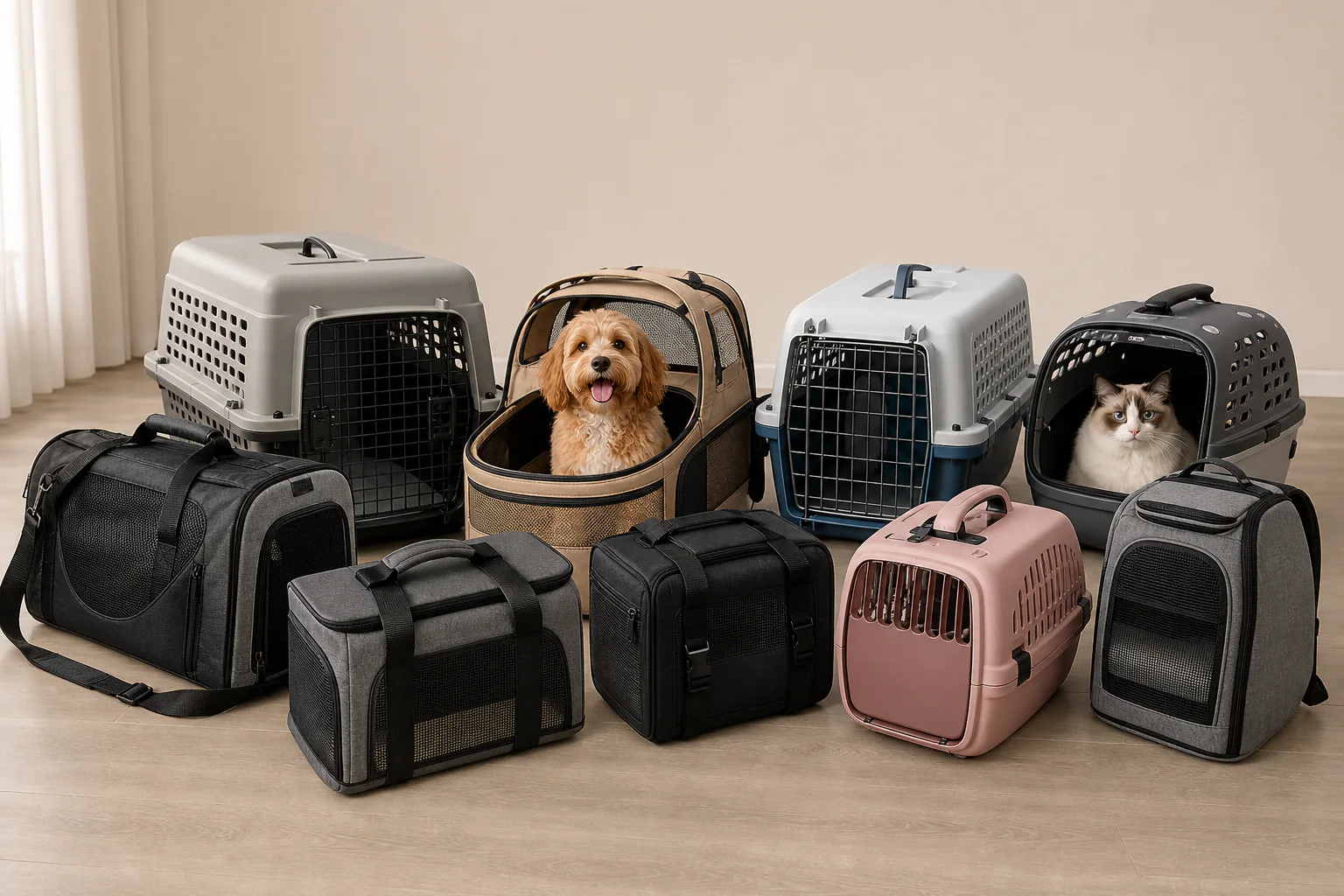
The right pet carrier depends on two measurements: your pet’s body size and the airline’s under-seat restriction. The ten options below compare exact dimensions, weight limits, construction, features, and best uses, followed by a measurement guide and airline-size table. An airline-approved label is not a substitute for checking the airline pet travel policy for your specific aircraft and route.
Quick comparison
| Pet carrier | Dimensions | Weight limit | Type | Best use |
|---|---|---|---|---|
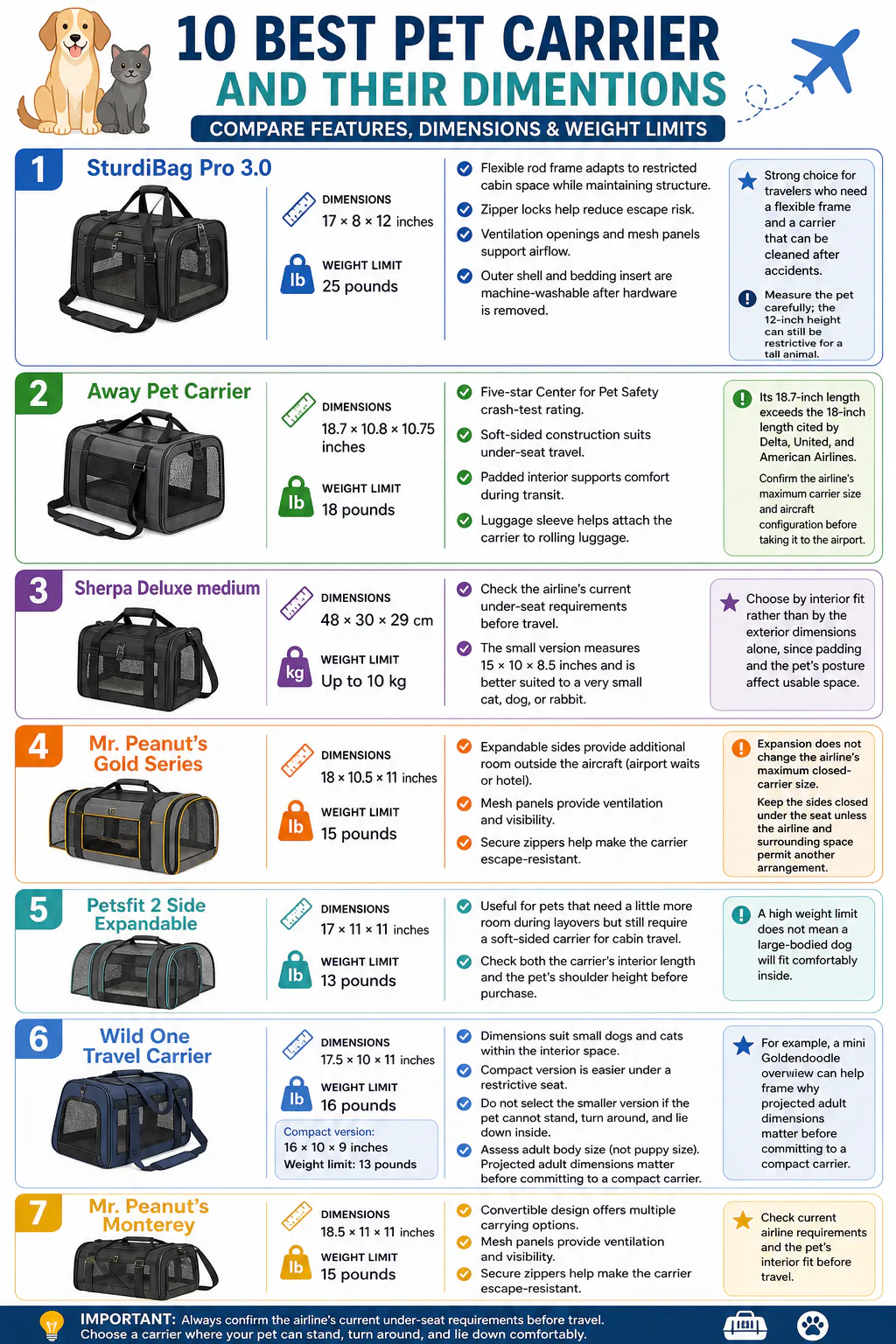
| SturdiBag Pro 3.0 | 17 × 8 × 12 in | 25 lb | Soft-sided carrier | Flexible in-cabin travel |
| Away Pet Carrier | 18.7 × 10.8 × 10.75 in | 18 lb | Soft-sided carrier | Crash-tested travel |
| Sherpa Deluxe, medium | 48 × 30 × 29 cm | 10 kg | Soft-sided carrier | Compact flights |
| Mr. Peanut’s Gold Series | 18 × 10.5 × 11 in | 15 lb | Expandable soft-sided carrier | Longer flights and under-seat travel |
| Petsfit 2 Side Expandable | 17 × 11 × 11 in | 13 lb | Expandable soft-sided carrier | Extra room during waiting periods |
| Wild One Travel Carrier | 17.5 × 10 × 11 in | 16 lb | Soft-sided carrier | Small dogs and cats |
| Mr. Peanut’s Monterey | 18 × 10 × 11 in | Not specified | Convertible backpack carrier | Hands-free city travel |
| Wild One compact configuration | 16 × 10 × 9 in | 13 lb | Compact soft-sided carrier | Smaller cats and dogs |
| Katziela Rolling Rover Wheeled Carrier | 20 × 12.25 × 10.5 in | 20 lb | Wheeled carrier | Ground transport and larger in-cabin pets |
| Petmate Two Door Plastic Kennel | 36 × 24.5 × 27 in | 30 lb | Hard-sided carrier | Road trips and cargo transport |
Dimensions are shown as length × width × height. A listed weight limit describes the carrier’s stated capacity, not automatic airline acceptance. The pet must also be able to stand, turn around, and lie down comfortably while secured inside.
Ten carriers worth considering
1. SturdiBag Pro 3.0
The SturdiBag Pro 3.0 measures 17 × 8 × 12 inches and has a 25-pound weight limit. Its flexible rod frame lets the soft-sided carrier adapt to restricted cabin space while maintaining structure.
- Zipper locks help reduce escape risk.
- Ventilation openings and mesh panels support airflow.
- The outer shell and bedding insert are machine-washable after the hardware is removed.
This is a strong choice for travelers who need a flexible frame and a carrier that can be cleaned after accidents. Measure the pet carefully because the 12-inch height can still be restrictive for a tall animal.
2. Away Pet Carrier
The Away Pet Carrier measures 18.7 × 10.8 × 10.75 inches and supports pets up to 18 pounds. It has a five-star Center for Pet Safety crash-test rating, which makes it a notable option for travelers who combine air travel with car journeys.
- Soft-sided construction suits under-seat travel.
- A padded interior supports comfort during transit.
- A luggage sleeve helps attach the carrier to rolling luggage.
Its 18.7-inch length exceeds the 18-inch length cited by Delta, United, and American Airlines. Confirm the airline’s maximum carrier size and aircraft configuration before taking it to the airport.
3. Sherpa Deluxe medium
The medium Sherpa Deluxe pet carrier measures 48 × 30 × 29 cm and supports pets up to 10 kg. Check the airline’s current under-seat requirements before travel.
The small version measures 15 × 10 × 8.5 inches and is better suited to a very small cat, dog, or rabbit. Choose by interior fit rather than by the exterior dimensions alone, since padding and the pet’s posture affect usable space.
4. Mr. Peanut’s Gold Series
The Mr. Peanut’s Gold Series Expandable Pet Carrier measures 18 × 10.5 × 11 inches and has a 15-pound weight limit. Its expandable sides provide additional room when the carrier is outside the aircraft, such as during airport waits or at a hotel.
- Expandable sides add temporary resting space.
- Mesh panels provide ventilation and visibility.
- Secure zippers help make the carrier escape-resistant.
Expansion does not change the airline’s maximum closed-carrier size. Keep the sides closed under the seat unless the airline and surrounding space permit another arrangement.
5. Petsfit 2 Side Expandable
The Petsfit Expandable Pet Carrier measures 17 × 11 × 11 inches and supports pets up to 13 pounds. It is useful for pets that need a little more room during layovers but still require a soft-sided carrier for cabin travel.
Check both the carrier’s interior length and the pet’s shoulder height before purchase. A high weight limit does not mean a large-bodied dog will fit comfortably inside.
6. Wild One Travel Carrier
The Wild One Travel Carrier measures 17.5 × 10 × 11 inches and supports pets up to 16 pounds. Its dimensions suit small dogs and cats whose body measurements remain within the interior space.
For particularly small animals, a compact configuration measures 16 × 10 × 9 inches and has a 13-pound weight limit. The smaller version is easier to manage under a restrictive seat, but it should not be selected if the pet cannot stand, turn around, and lie down inside.
Owners traveling with a small mixed-breed dog should assess adult body size rather than current puppy size. For example, a mini Goldendoodle overview can help frame why projected adult dimensions matter before committing to a compact carrier.
7. Mr. Peanut’s Monterey
The Mr. Peanut’s Monterey Series Convertible Backpack measures 18 × 10 × 11 inches and is designed for cats and smaller animals. Backpack straps are useful when walking through terminals, while a shoulder strap provides another carrying position.
- Backpack-style carrying keeps both hands available.
- Mesh panels support ventilation.
- A structured base helps maintain the carrier’s shape.
Backpack straps do not make a carrier suitable for every pet. Check whether the animal remains balanced and calm when the carrier is lifted, and confirm that the closed dimensions fit the airline’s under-seat space.
8. Best Wheeled In-Cabin Carrier: Katziela Rolling Rover Wheeled Carrier
The Katziela Rolling Rover Wheeled Carrier measures 20 × 12.25 × 10.5 inches and supports pets up to 20 pounds. Its wheels reduce lifting during long terminal walks, while the carrier’s closed dimensions must still fit the airline’s under-seat requirements.
The 20-inch length is larger than the 18-inch limit cited by Delta, United, and American Airlines. A wheeled design also needs enough aisle and gate space, so confirm both the airline’s size rules and whether the carrier must be carried rather than rolled during boarding.
9. Best Large Cargo Kennel: Petmate Two Door Plastic Kennel
The Petmate Two Door Plastic Kennel measures 36 × 24.5 × 27 inches and has a 30-pound weight limit. This hard-sided cargo kennel is intended for road trips, larger spaces, and cargo-style transport rather than routine under-seat travel.
- Hard-sided walls provide durable structure.
- Plastic surfaces are easier to wipe clean.
- The larger interior accommodates pets that cannot fit in a compact in-cabin carrier.
Do not use a cargo kennel in the cabin simply because it meets the pet’s body measurements. Airlines specify carrier construction, maximum carrier size, ventilation, and placement separately.
10. Sherpa Deluxe small
The small Sherpa Deluxe measures 15 × 10 × 8.5 inches. It is the most compact option in this comparison and suits small cats, rabbits, and very small dogs that can maintain a comfortable posture inside.
A compact carrier can be easier to place under a seat, but excessive compression is unsafe. The correct choice leaves enough room for the pet to stand, turn around, and lie down without the carrier pressing against the body.
How to measure your pet
Measure the pet while standing naturally on a level surface. Take the measurements before buying the carrier, and repeat them if the animal is still growing or changing weight.
- Measure length: Measure from the base of the neck to the base of the tail. Add enough space for the pet to turn without forcing the shoulders against the carrier wall.
- Measure height: Measure from the floor to the top of the head or the highest point of the ears, whichever is taller. Do not compress upright ears.
- Check width: Measure across the widest part of the body, usually the shoulders or hips. The carrier should not force the pet to stand with its legs pressed together.
- Compare the interior: Product dimensions may describe the outside of the carrier. Account for padding, frame components, and the removable liner.
- Check weight: Compare the pet’s current weight with the carrier’s weight limit, but do not use weight alone to determine the correct size.
A large dog such as an Alaskan Malamute will generally require a larger hard-sided carrier or cargo kennel, while a small adult cat may fit a compact soft-sided carrier. Breed, body shape, coat, and posture all affect the practical fit.
Airline carrier size limits
Airline rules change by route, aircraft, cabin, and carry-on allowance. The following figures are useful planning references, but the airline must confirm the permitted carrier before departure.
| Airline | Published or cited carrier limit | Important detail |
|---|---|---|
| Delta Air Lines | 18 × 11 × 11 in | Soft-sided in-cabin carrier reference |
| United Airlines | 18 × 11 × 11 in | Soft-sided in-cabin carrier reference |
| American Airlines | 18 × 11 × 11 in | Soft-sided in-cabin carrier reference |
| JetBlue | 17 × 12.5 × 8.5 in | A carrier measuring 16 × 8.5 × 10 in has a 20-pound weight limit |
| Southwest Airlines | 18.5 × 13.5 × 8.5 in | Maximum carrier size reference |
| Alaska Airlines | 17 × 11 × 9.5 in | Typical in-cabin size reference |
| WestJet | 16 × 8.5 × 10 in | 41 × 21.5 × 25.4 cm, listed as length × height × width |
| Air Canada | 17 × 16 × 8 in to 22 × 16 × 10 in | Dimensions vary by aircraft |
| Lufthansa | 21.7 × 15.7 × 9.1 in | Combined pet-and-carrier limit of 8 kg, or 17.6 lb |
| KLM | 18 × 11 × 9 in | Closed carrier and combined limit of 8 kg, or 17.6 lb |
| Air France | 17 × 9 × 12 in | EliteField Soft-Sided Pet Carrier; airline approved |
WestJet’s dimensions are expressed in a different order from the other entries, so check the airline’s exact length, width, and height labels before comparing carriers. Air Canada’s range also shows why aircraft-specific confirmation matters.
Some airlines count a pet carrier toward the passenger’s carry-on allowance or limit the number of cabin pets. Confirm fees, booking requirements, pet travel documents, health paperwork, and under-seat placement before purchasing a ticket.
Travelers extending a flight into a longer stay should plan the destination as carefully as the carrier. A list of pet-friendly hotels in the USA can help identify lodging where the carrier and pet-care routine will remain practical after arrival.
Soft-sided versus hard-sided
| Feature | Soft-sided carrier | Hard-sided carrier |
|---|---|---|
| Air travel | Flexible and lighter for under-seat placement | Less adaptable to restricted cabin space |
| Durability | Depends on frame, fabric, mesh, and zipper construction | Rigid walls provide durable structure |
| Cleaning | Look for a removable liner and washable bedding | Plastic surfaces are easier to wipe clean |
| Road travel | Requires reliable seat-belt attachments or a seat-belt tether | Useful when secured correctly in the vehicle |
| Cargo transport | Not suitable for every cargo requirement | Use a purpose-built cargo kennel that meets the carrier’s rules |
Soft-sided carriers are the practical starting point for in-cabin travel because their flexible walls can fit beneath a seat. Hard-sided carriers are better suited to road trips, rough handling, and situations where rigid structure and easy cleaning are priorities.
For vehicle travel, select a carrier with a secure seat-belt attachment or use a carrier designed for vehicle restraint. The Tavo Dupree attaches to rigid metal child-seat anchors, providing a different approach from a basic shoulder strap or luggage sleeve.
Safety features to check
- Ventilation: Look for mesh panels on multiple sides, while ensuring the openings cannot be pushed outward by the pet.
- Secure closures: Escape-resistant, secure zippers and zipper locks help prevent accidental openings.
- Interior support: Choose a padded interior with washable bedding or a removable liner.
- Privacy: A privacy screen can reduce visual stimulation, but it must not block adequate ventilation.
- Moisture control: A water-resistant lining helps contain spills and accidents.
- Vehicle restraint: Use a seat-belt tether or rigid child-seat attachment when the carrier is approved for that purpose.
- Crash protection: A crash-tested carrier provides more meaningful safety information than an unverified marketing label.
- Hardware: Inspect mesh, seams, frame rods, handles, and shoulder straps before every trip.
The Sleepypod Air has bendable bottom edges, a water-resistant lining, a padded bedding insert, and independent crash testing with a four-star Center for Pet Safety rating. It is a useful example of why air-travel convenience and vehicle-safety features should be evaluated separately.
Pet carrier FAQ
What is an ideal size for a pet carrier?
The ideal size allows the pet to stand, turn around, and lie down comfortably while secured. Measure the pet’s body and compare those measurements with the carrier’s usable interior, then check the airline’s maximum carrier size.
What are the dimensions of an Air Canada pet carrier?
Air Canada soft-sided carrier limits range from 17 × 16 × 8 inches to 22 × 16 × 10 inches, depending on the aircraft. Confirm the exact dimensions for the booked flight.
What are the dimensions of a WestJet pet carrier?
WestJet lists a maximum under-seat carrier size of 41 × 21.5 × 25.4 centimeters, or 16 × 8.5 × 10 inches. The airline must confirm the accepted orientation and carrier type for your itinerary.
What type of pet carrier is best?
A soft-sided carrier is the better starting point for in-cabin and under-seat travel. A hard-sided carrier is better for road trips, easier cleaning, and cargo kenneling, while a backpack or wheeled carrier helps with specific mobility needs.
Can my pet use an expandable carrier on a flight?
Yes, if the carrier meets the airline’s closed dimensions and the pet remains under the seat as required. Keep expandable sides closed during the flight unless airline staff approve another arrangement.
Does the carrier count as carry-on luggage?
It can count toward or affect the airline’s carry-on allowance. Check the airline’s current pet policy, fees, cabin-pet limit, and baggage rules before travel.
Final verdict
Choose the SturdiBag Pro 3.0 for a flexible soft-sided carrier, the Away Pet Carrier for crash-tested travel, the Mr. Peanut’s Gold Series for expandable cabin use, and the Monterey for backpack-style transport. The large plastic cargo kennel is the better match for pets that need rigid space, road travel, or cargo handling.
Before booking, measure the pet, compare the usable interior, confirm the airline’s exact under-seat dimensions, and prepare the required pet travel documents. Airline rules, aircraft space, fees, and restrictions can change, so final approval must come from the operating airline.